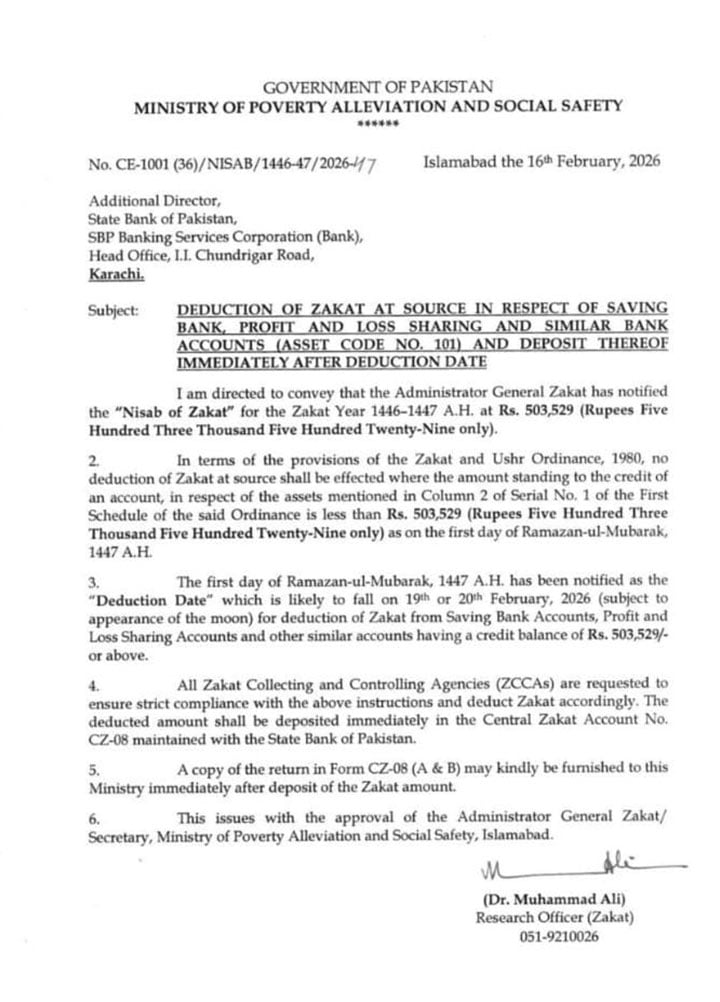
The structural re-evaluation of national financial metrics has calibrated the Zakat Nisab 2026 for Pakistan at Rs. 503,529. Consequently, Zakat will only be systematically deducted from savings accounts if their balance precisely meets or exceeds this critical threshold. This strategic adjustment, officially announced by the Ministry of Poverty Alleviation and Social Safety, ensures that accounts below this value on the first day of Ramadan 2026 remain exempt from automatic deduction.
What This Calibrated Nisab Implies for Citizens
The Translation: Demystifying Zakat Deduction Mechanics
An official notification specifies the procedural baseline for Zakat collection. Significantly, the deduction will occur on the first day of Ramadan, anticipated for February 19, 2026, pending moon sighting verification. This directive applies comprehensively to savings bank accounts, profit and loss sharing accounts, and analogous deposit instruments. Furthermore, this precise timing and scope underscore the government’s commitment to a standardized and transparent collection process.
Structural Shift: Analyzing the 180% Increase in Nisab
The Socio-Economic Impact: Recalibrating Financial Responsibilities
This year’s Zakat Nisab 2026 represents a substantial 180 percent increase from the previous year’s threshold of Rs. 179,689. This significant recalibration is directly attributable to the sharp appreciation in the market value of precious metals, specifically gold and silver, across both international and domestic markets. The data indicates this elevated threshold will markedly reduce the number of bank accounts automatically qualifying for Zakat deduction. With Pakistan’s banking system managing over 177 million accounts, spanning commercial banks, microfinance institutions, and fintech platforms, this revision has a broad, systemic impact.
For the average Pakistani citizen, this elevated Pakistan Zakat threshold means a larger segment of the population may no longer be subject to automatic Zakat deductions from their savings. Students and emerging professionals with modest savings, for instance, are less likely to meet the new Nisab, preserving their capital. Similarly, households across urban and rural Pakistan, particularly those navigating economic fluctuations, will experience a reduced immediate financial obligation from their bank balances. This adjustment directly impacts personal financial planning and stability for millions.
Operational Directives and the Forward Path
The “Forward Path”: A Strategic Stabilization Move
To ensure robust implementation, banks and all financial institutions have received stringent directives: they must ensure strict compliance and promptly deposit all collected Zakat into the Central Zakat Account at the State Bank of Pakistan following deduction. Moreover, institutions are mandated to submit official returns, thereby fortifying the transparency and accountability framework surrounding Zakat collections. This calibrated approach solidifies the procedural integrity of the system.
From an analytical perspective, this development represents a Stabilization Move. The adjustment reflects a reactive calibration to market dynamics rather than a proactive systemic shift. While it optimizes collection efficiency by targeting higher-value assets, it primarily maintains the existing framework’s operational integrity under new economic conditions. It is a necessary re-anchoring, not a fundamental re-engineering of the Zakat system.