In a significant structural adjustment, OpenAI has initiated the calibrated testing of ChatGPT ads for users on its Free and Go subscription tiers within the United States. This strategic pivot aims to underpin the broader accessibility of advanced ChatGPT features, thereby supporting ongoing innovation and expansion. Crucially, conversations maintain privacy from advertisers, and users on premium plans remain unaffected by this monetization framework. This move prompts a critical examination of AI service models and their long-term sustainability.
The Translation: Deconstructing OpenAI’s Revenue Strategy
OpenAI, a leading AI research and deployment company, confirmed its pilot program for integrating advertisements. Specifically, this affects individuals accessing ChatGPT through its free tier and the recently introduced “Go” plan, priced at $8 per month in the US. Enterprise-level and existing premium subscribers, including Plus, Pro, Business, and Education tiers, will experience no changes. Consequently, this segmentation ensures that core business and professional users retain an ad-free experience, preserving their workflow integrity.
Furthermore, OpenAI has provided explicit assurances regarding user data. The company states that advertising will not compromise how ChatGPT generates responses. Moreover, personal conversations will remain strictly private from advertisers. This foundational commitment to privacy is paramount, especially when handling sensitive user queries. The ads primarily serve to subsidize the high operational costs associated with developing and maintaining advanced AI systems.

In contrast, rival AI firm Anthropic publicly critiqued OpenAI’s decision through Super Bowl commercials. These ads depicted AI chatbots delivering advice alongside poorly targeted advertisements, subtly suggesting a potential disruption to user experience from poorly integrated ads. Despite such industry scrutiny and prior user resistance to similar trials, OpenAI maintains its trajectory toward diversified revenue streams, essential for sustainable growth in the competitive AI landscape.
Socio-Economic Impact: Recalibrating Digital Access for Pakistan
The introduction of ChatGPT ads could recalibrate how Pakistani citizens engage with advanced AI tools. For students, free access to powerful AI is a transformative resource, yet ad integration might introduce minor interruptions in their learning flow. Nevertheless, this strategy ensures continued, democratized access to a critical educational and research utility that might otherwise become cost-prohibitive for many.
Professionals across various sectors, particularly those relying on the free tier for initial research or task automation, will navigate an evolving digital environment. While ads might present minor cognitive load, they could also surface relevant tools or services, potentially enhancing efficiency. For urban households, AI chatbots become more financially viable for daily assistance and information retrieval, bridging digital divides. In rural Pakistan, where internet access is often limited, this model prioritizes the baseline availability of AI, potentially fostering greater digital literacy and adoption over time.

The Forward Path: Momentum Shift or Stabilization Move?
This development represents a calculated Stabilization Move for OpenAI. By diversifying its revenue streams through targeted advertising on free tiers, the company secures a more robust financial baseline. This, in turn, provides the essential capital required for sustained research and development, which is critical for pushing the boundaries of AI capabilities. Consequently, this strategic decision underpins a long-term Momentum Shift in AI innovation, ensuring that groundbreaking advancements can continue without solely relying on high-cost premium subscriptions.
The calibrated implementation, coupled with strong privacy assurances and user controls, positions this as a strategic recalibration rather than a radical departure. It reflects a pragmatic approach to financing the future of AI, balancing widespread accessibility with the formidable costs of advanced technological development.
Strategic Ad Integration and User Autonomy
OpenAI has meticulously outlined how these advertisements will appear. Ads will be explicitly labeled as “sponsored content” and segregated from organic chatbot responses. The company categorically denies that ad placements will influence the factual integrity or nature of AI-generated answers. Instead, their placement is optimized based on a nuanced understanding of user intent and conversation topics, ensuring relevance and utility.
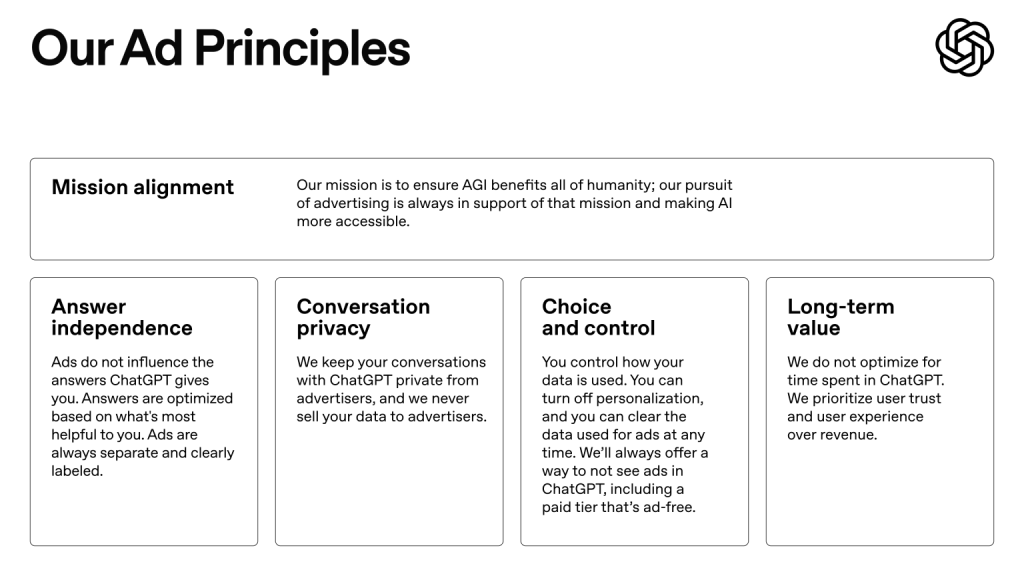
During initial testing phases, ads were contextually matched to discussion topics, historical chat logs, and previous ad interactions. For instance, a user researching healthy recipes might encounter ads for grocery delivery services or specialized meal kits. This precision targeting aims to deliver value without being overtly intrusive. OpenAI also mandates that advertisers will not gain access to individual user data, receiving only aggregate performance metrics such as views and clicks, thereby upholding user privacy protocols.
Moreover, OpenAI is implementing robust user controls to maintain autonomy over their experience. Users can inspect and clear their ad interaction history, dismiss specific advertisements, and provide direct feedback. Additionally, they retain the ability to manage personalized ad settings. Critically, advertisements will not be displayed to users under 18 years of age, nor will they appear alongside sensitive or regulated subjects, including content related to health, politics, or mental wellness. This structural framework underscores a commitment to responsible AI monetization.