

In a strategic move to standardize academic progression, the Punjab Education, Curriculum, Training and Assessment Authority (PECTAA) in Lahore has officially released the date sheet for the Punjab Class 8 Exams 2026. This critical announcement outlines a meticulously planned four-day examination schedule, commencing in March. Consequently, students, educators, and parents can now calibrate their preparation strategies with precision. This proactive release ensures optimal transparency and structural efficiency within the examination system, thereby facilitating a smoother academic transition for thousands of Grade 8 students across Punjab.
Calibrating Academic Pathways: Punjab Class 8 Exams 2026 Schedule

The PECTAA’s latest directive establishes a clear framework for the upcoming annual assessments. Furthermore, these guidelines aim to maintain a high degree of operational integrity. The core examinations are precisely scheduled from March 9, 2026, to March 12, 2026. All papers will be conducted during a standardized window, from 9:00 AM to 12:00 PM, ensuring consistent time management for all candidates.
Precision Timelines: Core Subject Examination Dates
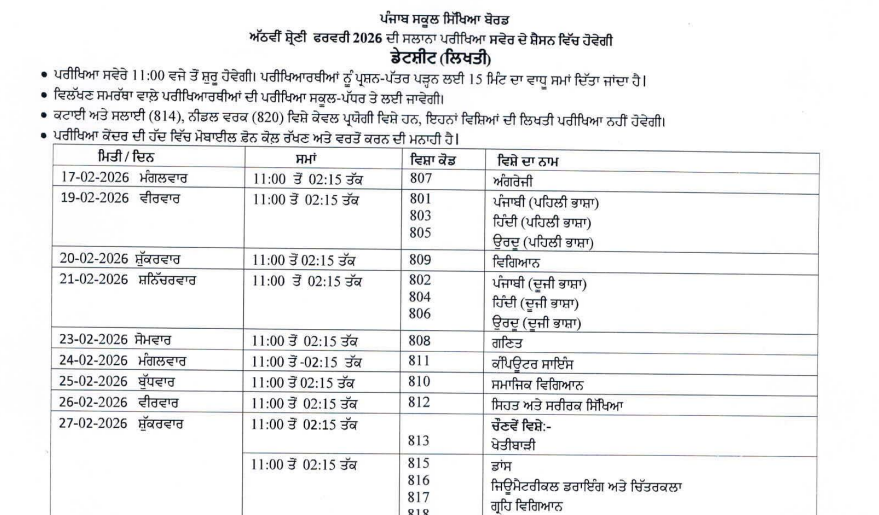
The examination sequence is structured to optimize student focus and performance. Specifically, the schedule is as follows:
- Monday, March 9: Mathematics
- Tuesday, March 10: Urdu
- Wednesday, March 11: English
- Thursday, March 12: Science
This sequential approach allows for dedicated preparation, fostering an environment conducive to optimal academic output.
Decentralized Assessments: The Role of School-Based Evaluation

Beyond the core subjects, PECTAA has mandated that individual schools will manage all other Grade 8 papers. This is accomplished through the Integrated Bank System (IBS) facility, operating under the established School Based Assessment (SBA) model. Consequently, this decentralization empowers institutions to tailor evaluations while adhering to a broader regulatory framework. The Authority will additionally disseminate the schedules for remaining subjects, alongside the End of Year Term Assessment 2026 for other academic grades, in due course.
Optimizing Examination Protocol: Essential Directives for Candidates
To ensure a fair and secure testing environment, PECTAA has issued stringent instructions for all candidates appearing in the Punjab Class 8 Exams. These guidelines are designed to uphold the integrity of the examination process and standardize conduct across all centers.
Structural Integrity: Prohibited Items and Entry Requirements

Candidates must adhere strictly to the following prohibitions and requirements:
- Prohibited Items: Calculators, mobile phones, smart watches, and any other electronic devices are strictly forbidden within the examination center.
- Arrival Time: Students must arrive at the examination hall at least 30 minutes prior to the scheduled start of the paper. This ensures timely verification and minimizes disruption.
- Entry Essentials: Presentation of both the B Form and the roll number slip is mandatory for entry into the center. These documents serve as critical identification.
- Permitted Stationery: Students are directed to bring a blue or black ballpoint pen and a clipboard. Those sitting for the Mathematics paper must also provide their own geometry box.
Procedural Adherence: Answer Booklet and Conduct Guidelines
Furthermore, the Authority explicitly directs students to utilize only the provided answer booklet for both objective and subjective sections. Critically, no additional sheets will be issued. Students are also strictly prohibited from vacating the examination hall before the paper officially concludes. This structural integrity ensures controlled conditions throughout the assessment period.
The Translation: Deconstructing Examination Frameworks
The PECTAA’s announcement signifies more than just dates; it reflects a systemic approach to educational assessment. The “School Based Assessment” (SBA) model, facilitated by the IBS system, is a pivot towards localized evaluation. This means that while core subjects undergo a centralized board examination, other subjects are assessed at the school level. The underlying logic is to empower schools with greater autonomy in evaluating specific learning outcomes while maintaining standardized accountability for fundamental subjects. Consequently, this balances centralized control with localized educational dynamics, fostering a more adaptive learning environment.
The Socio-Economic Impact: Precision Planning for Pakistani Families
This structured release of the Punjab Class 8 Exams date sheet profoundly impacts Pakistani citizens, particularly students and their families. For urban and rural households, precise dates mean earlier and more effective planning. Students can meticulously organize their study schedules, minimizing last-minute stress. Parents can coordinate logistics, such as transportation and study support, with greater efficiency. This clarity reduces anxiety and allows for optimized resource allocation, ensuring that academic progression is not hindered by uncertainty. Ultimately, this foundational clarity contributes to a more stable and predictable educational trajectory for young professionals in training.
The “Forward Path”: A Stabilization Move
This development represents a “Stabilization Move.” While not introducing radical educational reforms, the PECTAA’s clear and early communication of the Punjab Class 8 Exams schedule enhances system predictability and efficiency. It reinforces established protocols, minimizes ambiguity, and supports a disciplined academic environment. This precision in planning serves as a critical baseline, strengthening the operational integrity of our national education system. Further, it allows for a more controlled transition into higher grades, which is essential for sustained national advancement.
For those aspiring to further academic excellence, we strongly recommend exploring global scholarship opportunities. Visit EduNation to find tailored programs.








