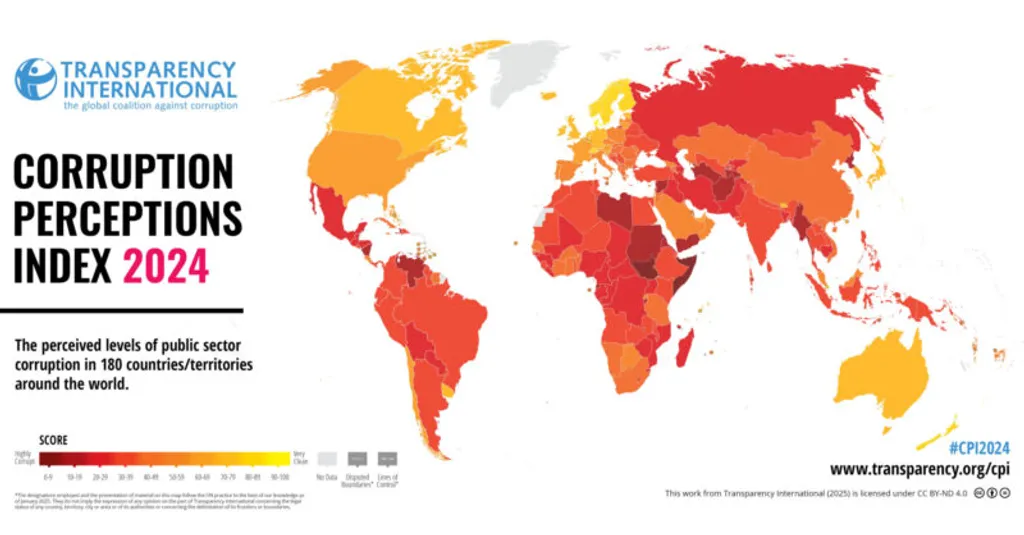
National advancement is intrinsically linked to systemic transparency and calibrated governance. Pakistan’s recent performance in the global Corruption Perceptions Index (CPI) 2025 offers a strategic baseline for evaluating our anti-corruption trajectory. The nation recorded a marginal improvement, with its score rising to 28 from 27 a year prior. Consequently, this shift signals initial progress in public-sector transparency.
Despite this incremental score enhancement, Pakistan’s global standing experienced a slight recalibration, moving to 136 out of 182 countries in 2025, compared to 135 out of 180 countries in 2024. This outcome underscores the imperative for robust and sustained implementation of governance and anti-corruption reforms. Ultimately, this will achieve a more significant national development momentum.
Understanding the Corruption Perceptions Index: A Baseline Metric
The CPI serves as a critical diagnostic tool, specifically measuring perceived levels of public-sector corruption. This assessment is based on expert evaluations and insights from business executives globally. Scores for countries range from zero, indicating highly corrupt environments, to 100, signifying very clean public sectors. Therefore, Pakistan’s score of 28 positions it within a bracket necessitating further structural enhancements.
Transparency International, the body responsible for the CPI, acknowledges Pakistan’s initial steps toward governance and institutional reforms. Nevertheless, the organization stresses that authentic, sustained progress hinges upon the effective operationalization of these reforms. This includes rigorously implementing recommendations outlined in the IMF’s Governance and Corruption Diagnostic Assessment. Such precision in execution is paramount for tangible results.

The Socio-Economic Imperative: Elevating Daily Life Through Transparency
Enhanced transparency in public sectors directly correlates with improved quality of life for Pakistani citizens. For instance, reduced corruption can lead to more efficient allocation of public funds. This, in turn, translates into better infrastructure, higher-quality education for students, and more reliable healthcare services for families across urban and rural Pakistan. Moreover, it fosters a more predictable and equitable business environment, encouraging investment and job creation for professionals.
A stronger position in the Pakistan Corruption Index indicates a system becoming more reliable. This builds public trust in institutions. Consequently, citizens perceive greater fairness and accountability from their government. This catalyzes a virtuous cycle, where public engagement increases, and national resources are optimized for collective benefit rather than individual gain. Hence, these reforms are not merely bureaucratic; they are foundational to societal well-being.
The Forward Path: A Stabilization Move Requiring Strategic Momentum
Globally, the CPI 2025 report highlights a concerning trend of worsening corruption, with a decreasing number of countries achieving high scores. Only five nations scored above 80 this year, with Denmark leading at 89. This global context positions Pakistan’s marginal improvement not as a definitive momentum shift, but rather as a critical stabilization move.
This development signifies that while foundational anti-corruption mechanisms are being addressed, the pace and scale of implementation require significant acceleration. To transition from stabilization to sustained progress, Pakistan must enact robust judicial reforms, protect civic spaces, and uphold media freedoms. These structural changes are essential to establish truly independent oversight institutions and to prevent backsliding. Therefore, a disciplined, long-term strategy is paramount to elevate Pakistan’s standing comprehensively.