

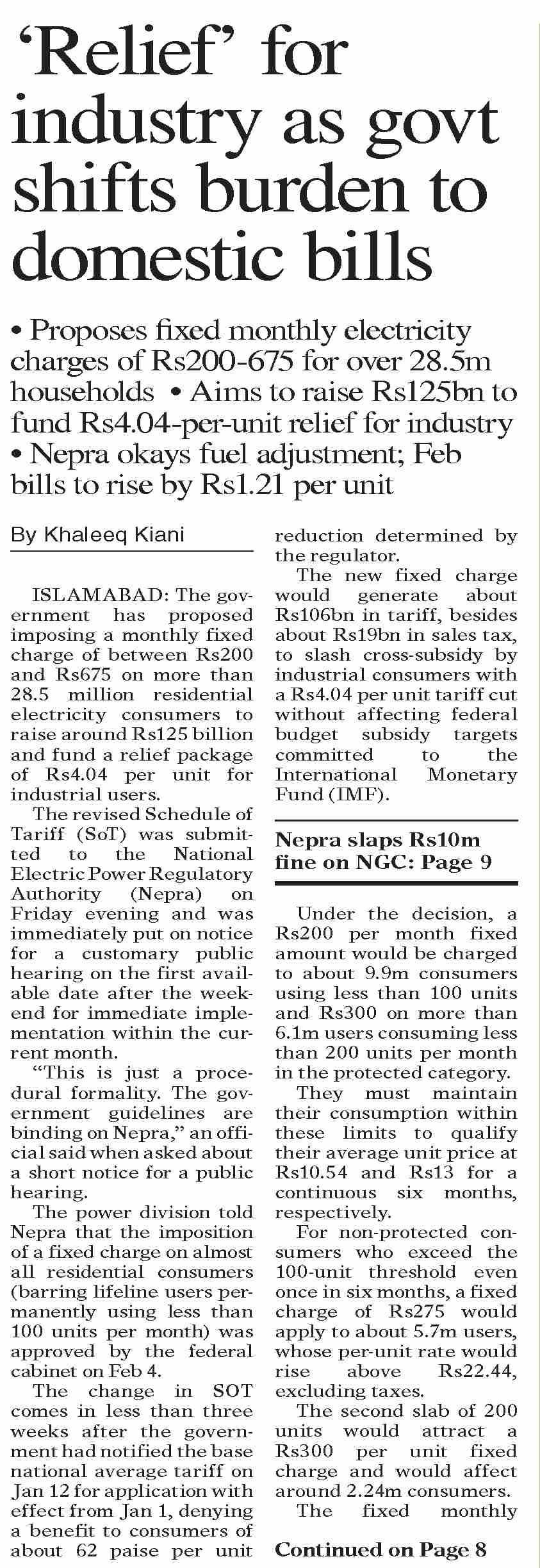
Pakistan’s energy infrastructure undergoes a critical recalibration, strategically shifting a significant portion of the Pakistan power costs burden from industrial users to over 28.5 million residential electricity consumers. This decisive governmental action, proposing a monthly fixed charge ranging from Rs. 200 to Rs. 675, aims to generate approximately Rs. 125 billion. Consequently, this revenue will fund a critical Rs. 4.04 per unit relief package for the industrial sector, fostering economic competitiveness and stabilizing national fiscal targets aligned with International Monetary Fund commitments. This structural adjustment, approved by the federal cabinet, underscores a strategic imperative to balance economic growth with grid sustainability.
The Translation: Deconstructing the Tariff Realignment
The federal government has initiated a calibrated revision within Pakistan’s electricity tariff schedule, formally submitting it to the National Electric Power Regulatory Authority (Nepra). This immediate action triggers a public hearing to facilitate implementation within the current month. The core of this policy is the imposition of a new fixed charge on nearly all residential consumers, excluding lifeline users consuming under 100 units monthly. Specifically, this decision, approved by the federal cabinet on February 4th, represents a strategic move to generate essential revenue. Furthermore, this structural change aims to reduce cross-subsidies currently borne by industrial entities, enabling a precise Rs. 4.04 per unit tariff reduction without compromising crucial subsidy targets previously committed to the IMF.
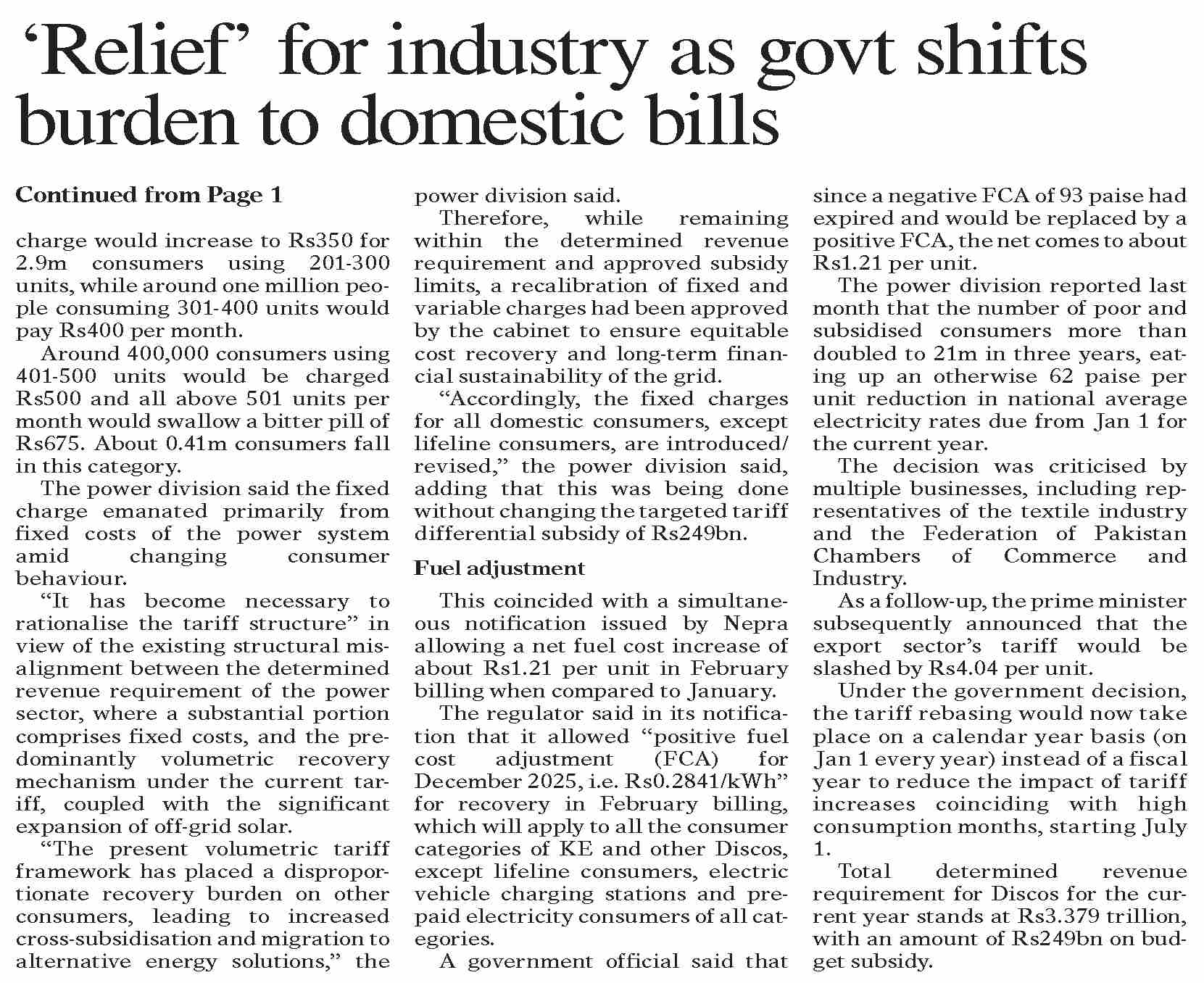
The power division explicitly projects that these new fixed charges will generate approximately Rs. 106 billion in tariff revenue, complemented by an additional Rs. 19 billion in sales tax. This revenue generation mechanism directly supports the industrial relief package. Crucially, this recalibration follows a previous tariff notification on January 12th, which denied consumers a determined 62 paisa per unit reduction. Therefore, the current proposal directly addresses an identified structural misalignment within the existing power recovery framework, ensuring long-term financial viability for the national grid.
Structural Adjustments: Calibrating Domestic Power Costs
The revised tariff structure systematically outlines various fixed charges for residential consumers, directly impacting millions of households. Under this proposal, approximately 9.9 million consumers utilizing less than 100 units monthly will incur a residential fixed charge of Rs. 200. Furthermore, over 6.1 million protected consumers, those using up to 200 units, will face a Rs. 300 charge. These specific user categories must consistently maintain their consumption within these stipulated limits for six consecutive months to qualify for baseline average unit prices of Rs. 10.54 and Rs. 13, respectively. This calibrated approach ensures equitable distribution of the revised cost structure regarding Pakistan power costs.
Conversely, non-protected consumers who exceed the 100-unit threshold even once within a six-month period will incur a fixed charge of Rs. 275. This category encompasses around 5.7 million consumers, for whom per-unit rates will exceed Rs. 22.44, excluding applicable taxes. The policy meticulously defines additional slabs to manage diverse consumption patterns. The subsequent tier, for users consuming up to 200 units, will attract a Rs. 300 fixed charge for approximately 2.24 million consumers. This structural segmentation precisely categorizes the user base.
For those consuming between 201 and 300 units, a Rs. 350 charge will affect nearly 2.9 million users. Moreover, approximately one million consumers in the 301 to 400-unit bracket will pay Rs. 400 per month. Users in the 401 to 500-unit range, totaling around 400,000, will face a Rs. 500 charge. Finally, consumers exceeding 501 units, a segment of about 0.41 million, will bear the highest fixed charge of Rs. 675. This tiered implementation reflects a granular approach to energy consumption management.
The Socio-Economic Impact: Navigating Daily Life Revisions
This tariff recalibration will significantly alter the daily financial landscape for millions of Pakistani citizens. For urban households, particularly those in middle and lower-income brackets, the fixed charge represents a baseline increase in their monthly electricity expenditure, irrespective of actual consumption. Consequently, this could necessitate a strategic re-evaluation of household budgets. Students in urban centers residing in shared accommodations or utilizing essential electronics will directly experience this increased burden, potentially impacting their disposable income for educational resources or basic necessities. This shift in Pakistan power costs demands careful financial planning.
In rural Pakistan, where economic resilience is often lower and energy conservation practices are already prevalent, this fixed charge poses a more acute challenge. Farmers, small business owners, and remote households will absorb additional costs, potentially constraining their capacity for investment or expansion. Professionals across both urban and rural settings will observe a reduction in their net discretionary income, influencing consumption patterns and potentially broader economic activity. Therefore, the policy’s structural impact extends beyond mere utility bills, touching fundamental aspects of socio-economic stability. This constitutes a systemic re-alignment of energy cost distribution.
Driving the Shift: Achieving System Alignment for Sustainability
The power division articulates that this energy policy Pakistan revision is primarily a response to fundamental shifts within the national power system. The increasing fixed costs of maintaining and expanding the grid, coupled with evolving consumer behavior, particularly the expansion of off-grid solar usage, necessitate this structural adjustment. This phenomenon creates a critical misalignment: while revenue requirements remain largely fixed, the existing volumetric recovery mechanism proves insufficient. Therefore, a calibrated approach to tariff structure becomes essential for long-term grid stability and operational efficiency. The government identifies this as a strategic imperative for managing Pakistan power costs effectively.

Furthermore, the existing framework inadvertently placed a disproportionate financial burden on certain consumer segments. This imbalance inadvertently encouraged migration towards alternative energy solutions, thereby exacerbating the challenge of cross-subsidization within the conventional grid. The federal cabinet has thus approved a precise recalibration of both fixed and variable charges. This strategic maneuver strictly adheres to the determined revenue requirement and the approved subsidy limit of Rs. 249 billion. Ultimately, this ensures the long-term financial sustainability of the grid, representing a proactive measure against systemic inefficiencies.
The “Forward Path”: Assessing Systemic Evolution
This recent governmental initiative to reallocate Pakistan power costs represents a Stabilization Move for Pakistan’s energy sector. While it does not fundamentally transform the energy generation matrix, it is a crucial, disciplined action aimed at rectifying structural financial imbalances within the existing grid infrastructure. The move precisely addresses the growing fixed costs and revenue shortfalls that have strained the system, particularly as consumer behavior shifts towards off-grid solutions. Therefore, this policy solidifies the financial baseline, preventing further deterioration of grid sustainability. It establishes a more robust framework for operational continuity rather than initiating a radical shift.

However, while providing immediate industrial electricity relief, the long-term trajectory requires careful monitoring. The shift of burden to domestic consumers, even with fixed charges, introduces new socio-economic pressures that demand future mitigation strategies. A genuine “Momentum Shift” would involve a more comprehensive overhaul, including significant investments in renewable energy infrastructure, advanced smart grid technologies, and enhanced energy efficiency programs for all sectors. This current step is a necessary corrective measure, providing a stable platform from which more transformative initiatives can potentially launch. It is a calculated step towards systemic resilience.
Strategic Implications for Pakistan’s Energy Future
The implementation of this revised tariff structure is a strategic recalibration essential for the financial health of Pakistan’s power sector. By ensuring the recovery of fixed costs and aligning with IMF subsidy targets, the government aims to stabilize the national energy infrastructure and rationalize Pakistan power costs. This move strategically safeguards industrial output, a critical component of national economic growth. However, future policy iterations must concurrently address the compounded burden on domestic consumers, perhaps through targeted relief programs or incentivizing distributed generation solutions. A holistic approach will optimize both economic competitiveness and citizen welfare.









