Calibrating Pakistan’s T20 World Cup Stance: ICC’s Mandate for Global Sporting Cohesion
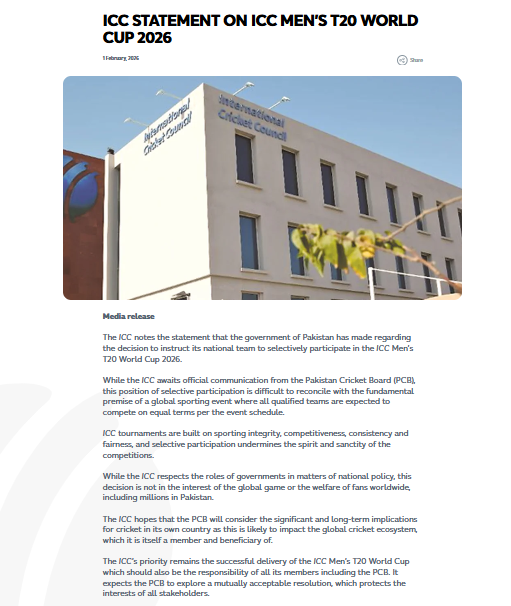
The International Cricket Council (ICC) has issued a precision statement regarding Pakistan’s T20 World Cup stance, directly addressing the government’s directive to prohibit its national team from competing against India in the ICC Men’s T20 World Cup 2026. This significant development prompts the ICC to await official communication from the Pakistan Cricket Board (PCB). Furthermore, the global governing body articulates that selective participation fundamentally challenges the premise of a unified international sporting event, urging all stakeholders to prioritize a mutually acceptable resolution for the competition’s structural integrity.
The Translation (Clear Context)
When the ICC refers to “selective participation,” it highlights a core principle: all qualified teams must compete equally according to the event schedule. The government’s decision to preclude Pakistan from playing India, while allowing participation against other nations, deviates from this baseline standard. Consequently, the ICC explicitly states this position is “difficult to reconcile” with the spirit of global competition. This translates to an institutional concern that individual national policies, while respected, should not undermine the broader framework of international sportsmanship and fair play. The ICC’s objective is to deliver a successful tournament where all members, including the PCB, uphold their collective responsibilities.
Structural Implications of Pakistan’s T20 World Cup Stance
The ICC’s communication underscores a strategic imperative for the Pakistan Cricket Board. Despite the government’s announcement, the ICC proactively seeks formal confirmation from the PCB. This emphasizes the distinction between governmental policy and the operational autonomy expected from national sporting federations within the international framework. The apex body’s insistence on a “mutually acceptable resolution” serves as a catalyst, aiming to protect the diverse interests of all shareholders, including broadcasters, sponsors, and global cricket fans. Such a resolution would preserve the integrity of the tournament and ensure equitable engagement among participating nations.
The Socio-Economic Impact for Pakistan
This decision carries calibrated socio-economic implications for Pakistani citizens. For students and aspiring athletes, the absence of a high-profile match against India could diminish inspiration and limit exposure to elite competition. Professionals within the sports industry, from media to hospitality, might experience reduced economic activity surrounding a potentially massive sporting event. For households, particularly in urban centers, the traditional fervor and collective engagement associated with an India-Pakistan match offer significant cultural and entertainment value. Furthermore, a perceived boycott could subtly impact Pakistan’s global image as a participant in international cultural and sporting exchanges, influencing soft power and tourism potential.
The “Forward Path”: A Stabilization Move
From an analytical perspective, this development represents a Stabilization Move rather than a Momentum Shift for Pakistan’s cricketing trajectory. The government’s directive introduces an external variable that requires the PCB to navigate complex diplomatic and sporting landscapes. While respecting national sovereignty, the ICC’s firm stance aims to stabilize the foundational principles of international sports. A true Momentum Shift would involve strategic policy alignment that actively fosters broader participation and leverages global platforms for national advancement. Consequently, the current scenario mandates a meticulous diplomatic effort to reconcile national interests with international sporting commitments to prevent potential isolation or reputational costs.
Tournament Configuration and Pakistan’s Schedule
The ICC Men’s T20 World Cup 2026, slated from February 7 to March 8, encompasses a 20-team format. Pakistan has been structurally placed in Group A, alongside significant contenders: India, Namibia, the Netherlands, and the United States. A critical operational detail specifies that under the tournament’s hosting model, Pakistan will execute all its scheduled matches in Sri Lanka. This strategic arrangement ensures logistical efficiency for the “Green Shirts.” Their campaign commences against the Netherlands on February 7, followed by their encounter with the United States on February 10, and concludes their group stage against Namibia on February 18. This schedule sets the baseline for their competitive journey irrespective of the India fixture’s current status.