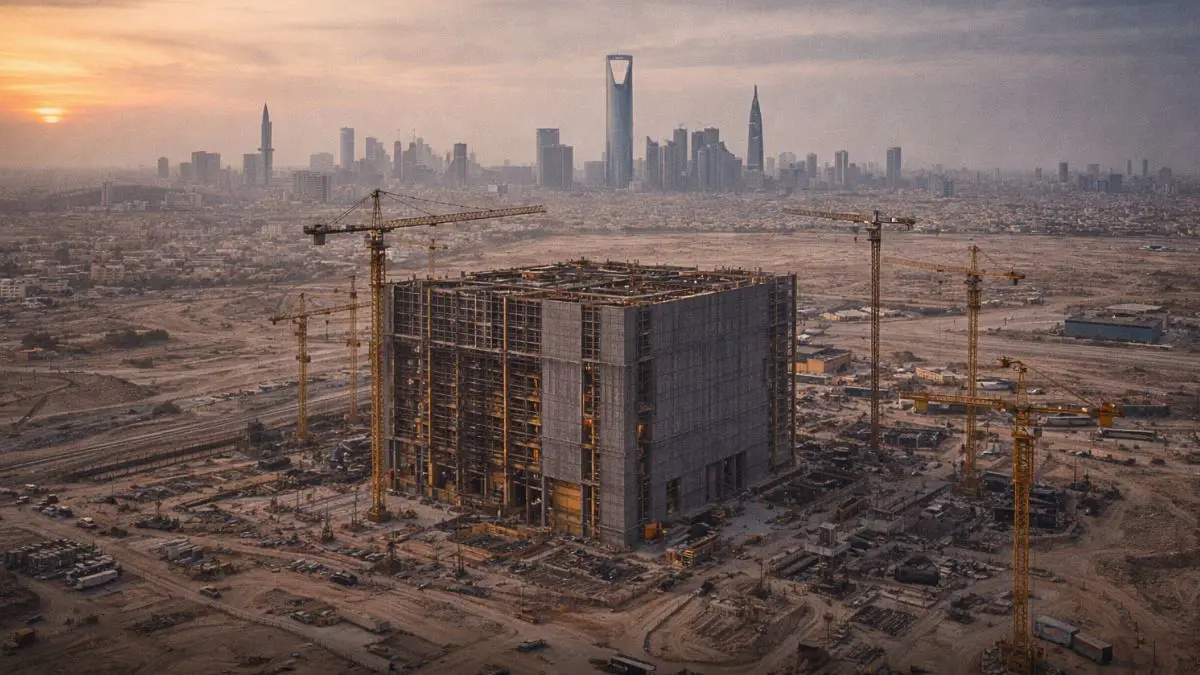
Riyadh’s urban development trajectory undergoes a critical calibration as Saudi Arabia announces a strategic Mukaab project pause. Authorities have suspended construction of “The Cube” megaproject, signaling a pivotal reassessment of financing and long-term feasibility within the ambitious Vision 2030 framework. This decision reflects a broader reprioritization of capital-intensive ventures, ensuring fiscal prudence as the Public Investment Fund (PIF) refines its investment strategy. Initial groundwork, such as soil excavation, has concluded, but further construction on the Mukaab itself is halted, even as the surrounding New Murabba real estate development continues its planned progression.
The Translation: Deconstructing Riyadh’s Strategic Pivot
The Mukaab, envisioned as a colossal 400m x 400m metal cube in Riyadh’s New Murabba downtown, was designed to redefine urban scale. This structure was projected to contain over two million square meters of interior floor space, a capacity equivalent to housing twenty Empire State Buildings. Furthermore, it featured plans for a massive AI-powered internal dome, positioning it as the world’s largest single-built structure. Consequently, its suspension marks a significant shift.
The Mukaab project pause stems from a broader strategic reprioritization of Vision 2030 megaprojects. Declining oil revenues and an $8 billion write-down on prior giga-projects by late 2024 necessitated this calibrated response. The PIF is now shifting its focus from highly capital-intensive endeavors towards financially viable initiatives. These include critical projects such as the 2030 World Expo, the 2034 FIFA World Cup, the Diriyah development, and the Qiddiya tourism project. Economy Minister Faisal al-Ibrahim affirmed the government’s commitment to transparently delaying or rescoping projects when economic baselines dictate such action.
The Socio-Economic Impact: Ripple Effects Across the Region
For Pakistani citizens, particularly those within professional and student demographics, such regional economic recalibrations carry indirect yet significant implications. The Mukaab project pause signifies a more cautious, data-driven approach to investment within Saudi Arabia. This precision could stabilize regional markets, potentially attracting skilled Pakistani labor to sectors deemed more fiscally robust, such as event management, sustainable tourism, or advanced infrastructure development linked to the World Expo or FIFA World Cup. Therefore, professionals seeking opportunities in the Gulf region might find their focus shifting towards these prioritized sectors.
Moreover, the extended timeline for the wider New Murabba development, now targeting 2040 with a $50 billion investment, indicates a prolonged demand for specialized expertise. This prolonged demand might open doors for long-term project engagement, benefiting Pakistani engineering, construction, and urban planning firms. Households, in turn, could experience indirect benefits through remittances and increased regional economic stability, which directly influences trade and investment flows with Pakistan. This move underscores a shift from grand, singular architectural statements to a diversified, multi-faceted investment strategy.
The “Forward Path”: A Strategic Stabilization Move
This Mukaab project pause represents a decisive “Stabilization Move” rather than a “Momentum Shift” in the traditional sense. Saudi Arabia is not abandoning its Vision 2030 but rather recalibrating its structural execution to ensure long-term sustainability. The PIF is demonstrating fiscal discipline by pausing projects that present substantial financial pressure in favor of initiatives with clearer, more immediate economic returns. This strategic adjustment is a necessary response to global economic shifts and internal fiscal realities. Consequently, it fortifies the foundational integrity of Vision 2030, ensuring its ambitious goals remain anchored in robust financial planning and calibrated implementation. This disciplined approach sets a new baseline for megaproject development in the region.