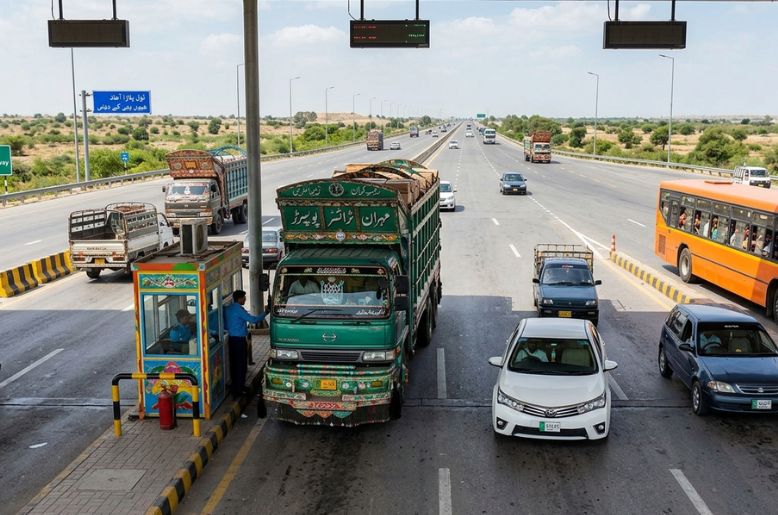
The Sindh Cabinet has calibrated a strategic shift in provincial logistics by approving a new Sindh highway toll on the 135-kilometre Nawabshah-Ranipur Mehran Highway. This fiscal mechanism aims to secure a dedicated, self-sustaining funding baseline for the artery’s long-term upkeep and structural rehabilitation. Consequently, the government ensures that critical infrastructure development remains independent of general budgetary fluctuations.
Strategic Impact of the New Sindh Highway Toll
Chief Minister Syed Murad Ali Shah chaired the cabinet session where officials confirmed that the toll system primarily targets heavy and commercial vehicles. Projections indicate a gross annual revenue of Rs2.14 billion. Furthermore, the net revenue is expected to reach Rs1.48 billion after accounting for operational precision. These proceeds will exclusively fuel the maintenance and further improvement of the highway, which is currently undergoing a Rs41 billion dualization process.
Broader Economic Calibrations: Wages and Food Security
In addition to infrastructure financing, the cabinet addressed labor economics by approving a 7.5% increase in minimum wages across Sindh. Effective July 1, 2026, the monthly wage for unskilled workers rises from Rs40,000 to Rs43,000. Simultaneously, the province is fortifying its food security framework by importing 0.5 million metric tons of wheat to bridge a projected shortfall of 1.69 million metric tons for the 2026-27 cycle.
Modernizing Land Governance
The proposed Sindh Government Lands Management Bill, 2026, represents a structural overhaul of colonial-era legislation. By replacing the 1912 Act, the new framework introduces market-based valuation and transparent public auctions. This legislative catalyst aims to streamline land allotment for agricultural, industrial, and residential purposes through a high-precision grievance redressal system.
The Situation Room Analysis
The Translation
The introduction of the Sindh highway toll is not merely a tax; it is a “User-Pay” model designed to ensure that the heavy commercial traffic responsible for road wear-and-tear contributes directly to its repair. By decoupling highway maintenance from the general treasury, Sindh is adopting a sustainable engineering management cycle used globally to maintain high-speed corridors.
The Socio-Economic Impact
For the average Pakistani citizen, these decisions create a dual effect. Improved road infrastructure reduces vehicle maintenance costs and travel time for transporters, which can stabilize the prices of goods. Meanwhile, the minimum wage increase provides a necessary inflation buffer for the province’s most vulnerable workforce, directly enhancing the purchasing power of thousands of households.
The Forward Path
This development represents a Momentum Shift. Moving from 114-year-old land laws to a modern management system shows a commitment to structural precision. If the revenue from the Sindh highway toll is transparently reinvested as promised, this could serve as a blueprint for self-funding provincial infrastructure projects across Pakistan.