
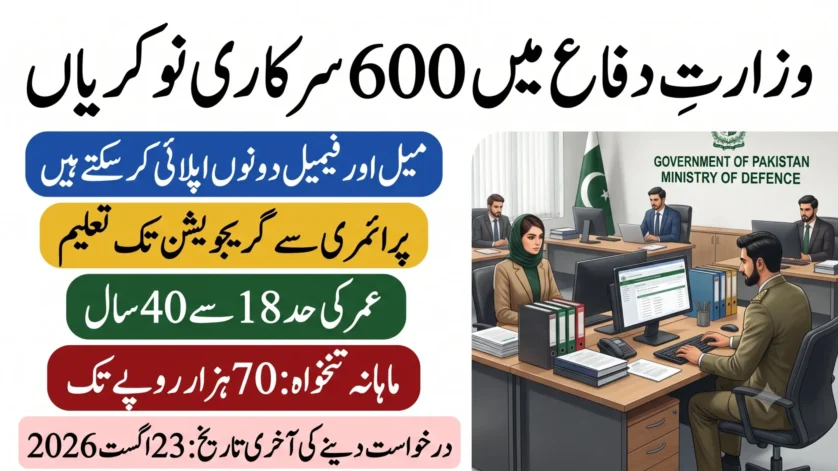
The Ministry of Defence Jobs initiative functions as a critical catalyst for national administrative resilience. Consequently, the Government of Pakistan has announced 600 vacancies to enhance technical and operational precision across the ministry. These roles range from BS-01 to BS-16 and strictly adhere to federal and provincial quotas. Therefore, this recruitment represents a structural upgrade to Pakistan’s defensive and administrative framework.
Ministry of Defence Jobs: A Calibrated Recruitment Drive
The Ministry seeks to recruit a diverse array of professionals to maintain system efficiency. Specifically, the department is hiring Architects, Software Developers, and IT Support Engineers. Furthermore, administrative precision is prioritized through vacancies for Manager Administration and Finance, Site Engineers, and Research Assistants. Operational roles including Traffic Analysts and Open Source Investigators are also available to bolster data-driven security measures.
Support staff roles are equally essential for infrastructure maintenance. The Ministry is accepting applications for:
- Technical Staff: Technicians, Electricians, and Site Supervisors.
- Operations: Field Operators, Special Operators, and Drivers.
- Administrative Support: Upper and Lower Division Clerks (UDC/LDC).
- Essential Services: Security Staff, Firefighters, and Naib Qasids.
Structural Eligibility and Application Protocol
Educational benchmarks for these Ministry of Defence Jobs vary by rank. Senior technical positions require a bachelor’s degree and professional certification. In contrast, support roles require matriculation or primary education. Candidates must fall between the ages of 18 and 30, although government-approved age relaxation applies to eligible individuals. To apply, candidates must utilize the official portal at www.recruitments.com.pk.

The Situation Room: Analysis
The Translation (Clear Context)
This recruitment drive is not merely a job announcement; it is a calibrated effort to modernize Pakistan’s defense bureaucracy. By integrating IT experts and software developers alongside traditional field operators, the Ministry is aligning its human capital with 21st-century technological demands.
The Socio-Economic Impact
For the average Pakistani citizen, these 600 vacancies offer more than employment; they provide structural stability for hundreds of families. By utilizing federal and provincial quotas, the government ensures an equitable distribution of resources, fostering economic inclusion across both urban and rural landscapes.
The “Forward Path” (Opinion)
This development represents a Momentum Shift. The strategic inclusion of high-tech roles such as Open Source Investigators and Software Developers suggests that the Ministry is pivoting toward a proactive, data-centric security model rather than a purely reactive one.