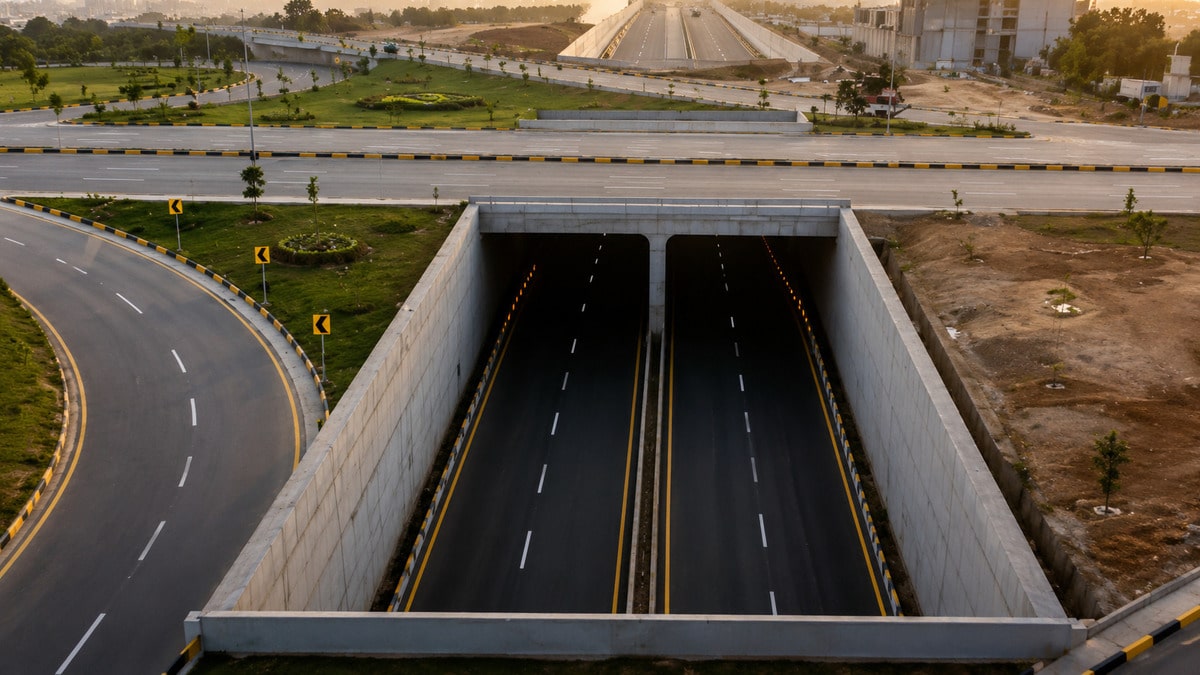
Structural integrity and precision define our national progress, yet the latest audit report of Islamabad’s infrastructure reveals a calibrated failure in engineering. The recent investigation into the Islamabad underpass design has uncovered a significant safety hazard at the 9th Avenue and Jinnah Avenue interchange. According to Audit Report DGAWF-26-002, the current structure poses a severe risk to motorists due to a sharp 45-degree turn positioned directly in front of a concrete wall.
Technical Calibration: Assessing the Islamabad Underpass Design Failure
The Auditor General of Pakistan (AGP) identified that the interchange’s underpass loop was designed for a speed of 30 km per hour. This represents a strategic deviation from the project’s original feasibility study, which specified a design speed of 60 km per hour. Consequently, this mismatch violates basic transportation engineering principles and creates an avoidable “death trap” for unsuspecting drivers.
The report characterizes this discrepancy as gross negligence and professional misconduct by the design consultant. Under the existing consultancy agreement, the Capital Development Authority (CDA) possesses the legal framework to recover damages up to twice the consultant’s fee. Furthermore, the committee has directed management to finalize the consultant’s report after receiving approval from the CDA chairman.
Financial Discrepancies and Procurement Irregularities
Beyond the Islamabad underpass design, the audit flagged several financial anomalies within CDA operations. These baseline figures suggest a lack of structural oversight in public spending. The irregularities include:
- Solid Waste Management: Payments reached Rs. 411.776 million for a contract originally valued at only Rs. 95.191 million.
- Sector C-15 Development: Irregular contracts worth Rs. 1,587.049 million were identified.
- F-10 Roundabout: An unjustified payment of Rs. 341 million was made for work outside the approved project scope.
- Healthcare Maintenance: Unauthorized expenditure of Rs. 7.134 million occurred at Capital Hospital for maintenance services without fresh bidding.
The Translation (Clear Context)
In “Next Gen” terms, the engineering firm fundamentally ignored the laws of physics and the project’s blueprint. By reducing the design speed by 50% and placing a solid wall at a high-velocity junction, they compromised system efficiency for short-term convenience. This is not merely a “mistake”; it is a failure to adhere to calibrated safety protocols.
The Socio-Economic Impact
This failure directly impacts the daily safety of Pakistani professionals and families navigating the capital’s main arteries. A flawed Islamabad underpass design increases accident frequency, which burdens our healthcare systems and causes logistical delays. Moreover, the wasted millions in procurement irregularities represent a loss of capital that could have funded digital literacy or energy-efficient urban cooling systems.
The Forward Path (Opinion)
This development represents a Stabilization Move. While exposing these flaws is a catalyst for accountability, true momentum will only shift when the CDA enforces strict penalties on negligent consultants. We must demand a baseline of engineering excellence where precision is non-negotiable. Reclaiming the design fees and redesigning the loop is the only way to ensure the safety of our citizens.