
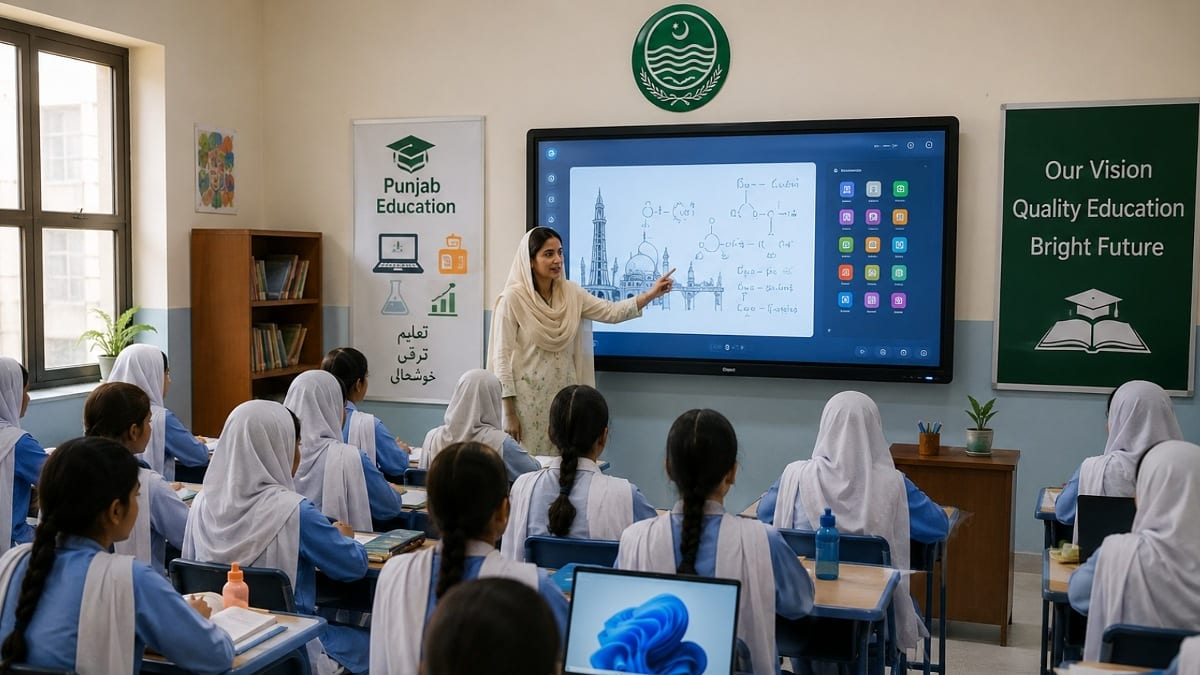
The Punjab AI curriculum faces a strategic delay as the provincial government grapples with a critical deficit of computer labs in primary schools. Consequently, the Punjab Education Curriculum Training and Assessment Authority (PECTAA) has postponed the formal integration of Artificial Intelligence for Grade 1 through Grade 5. While the curriculum framework is ready, the structural baseline of our public education system remains insufficient to support high-compute subjects. This bottleneck represents a significant challenge to the digital acceleration of our youth.
Strategic Barriers to the Punjab AI Curriculum Implementation
The absence of dedicated technological infrastructure has stalled the official notification required for academic rollout. Therefore, the production and precision printing of AI textbooks remain on hold until the baseline facilities are established. Strategically, officials are now debating whether to integrate AI concepts into existing science and mathematics subjects rather than launching a standalone course. This calibrated shift aims to bypass the immediate need for multimillion-rupee investments in specialized labs across thousands of rural and urban schools.
The Translation: System Logic vs. Practical Reality
In technical terms, PECTAA is navigating a hardware-software mismatch. The software—the curriculum—is ready for deployment, but the hardware—the physical computer labs—lacks the necessary capacity. By considering an integrated approach, the government seeks to deliver conceptual literacy without the immediate overhead of a full-scale lab deployment. This ensures that students learn the fundamental logic of AI even if they cannot yet access the digital interface. Consequently, the plan prioritizes knowledge over hardware access in the short term.
The Socio-Economic Impact: Widening the Digital Divide
For the average Pakistani student in a government school, this delay signifies a missed window of competitive opportunity. Paradoxically, the digital literacy gap continues to widen between private-sector students and those in the public sector. If primary students do not engage with systemic logic and computational thinking early, their future readiness in a globalized STEM economy remains at risk. This infrastructure gap specifically impacts households in rural Pakistan who rely on state-funded schools for modern skill acquisition.
The Forward Path: A Stabilization Move
This development represents a Stabilization Move. While the delay is a setback for national progress, launching a tech-heavy curriculum without functional labs would be a superficial vanity project. Building the infrastructure first is the more disciplined architectural choice. We must prioritize structural integrity over optics to ensure that when AI is finally taught, it is done with precision and practical utility. Pakistan’s digital frontier requires a calibrated foundation before a full-scale launch.








