
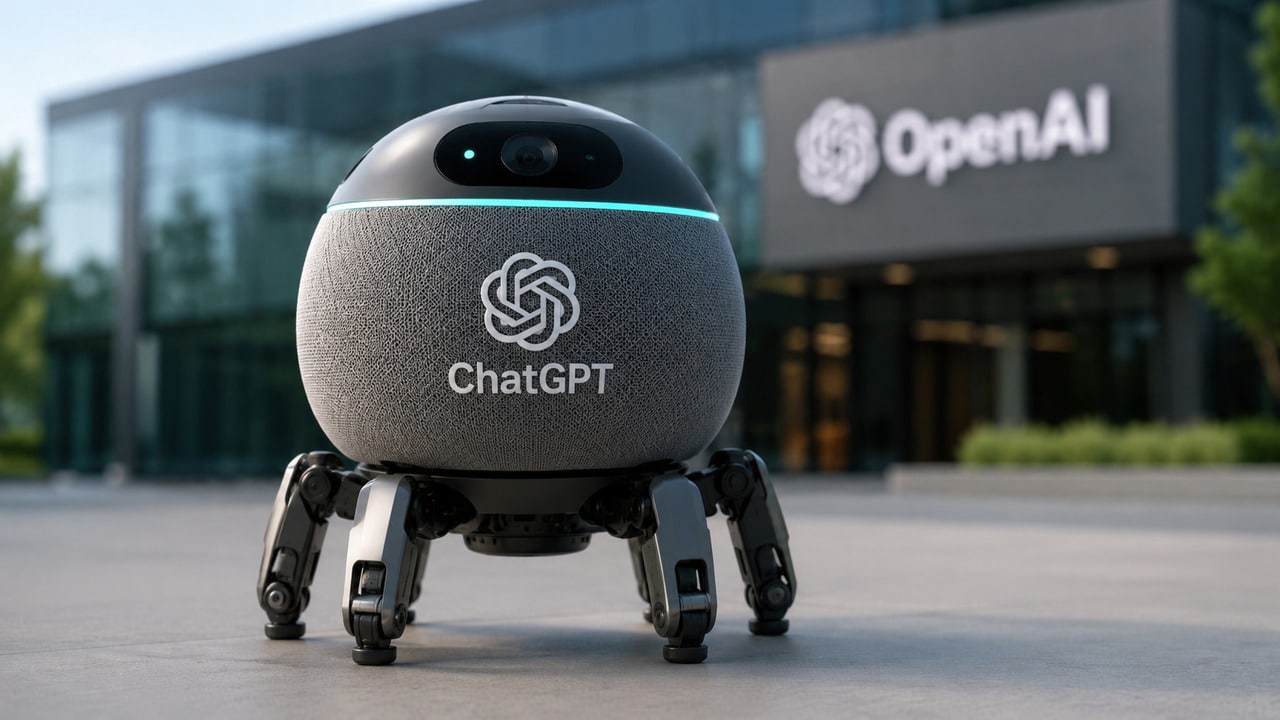
The global technological landscape is undergoing a calibrated shift from digital interfaces to physical, embodied intelligence. OpenAI’s upcoming OpenAI smart speaker represents a strategic evolution in hardware, moving beyond static audio output toward a dynamic, human-like robot companion. Consequently, this development signifies a transition where AI ceases to be a mere tool and becomes a proactive presence within the domestic ecosystem.
Engineering the OpenAI Smart Speaker for Human Connection
Engineers are designing this device to function without a traditional screen, relying instead on high-precision sensors and mechanical mobility. Unlike conventional static speakers, this hardware utilizes mechanical legs and integrated cameras to perceive its environment. Moreover, it leverages an advanced iteration of ChatGPT’s voice mode, allowing for seamless, real-time interruptions and natural dialogue. Strategically, OpenAI aims to create a device that anticipates needs rather than just reacting to specific prompts.
The technical architecture of the product draws from elite design lineages. Specifically, the project involves LoveFrom, the design studio led by former Apple executive Jony Ive. Furthermore, the development team comprises several former Apple engineers responsible for the structural foundations of the iPhone and Mac. This calibrated focus on aesthetics and utility suggests a product designed for high-frequency, long-term home use.
- Portability: Powered by rechargeable batteries for movement across diverse household terrains.
- Sensory Perception: Onboard cameras and sensors for spatial awareness and user recognition.
- Personality-Driven: Focuses on human-like conversation and adaptive learning.
- System Control: Serves as a central hub for smart home automation and media playback.
The Situation Room Analysis
The Translation (Clear Context)
In technical terms, OpenAI is moving from “narrow AI” software to “embodied AI” hardware. While traditional speakers act as voice-activated search engines, the OpenAI smart speaker acts as a mobile agent. It utilizes multimodal learning, meaning it processes what it sees and hears simultaneously to build a baseline of user context. This shift removes the barrier of screen-based navigation, making the power of ChatGPT accessible through pure physical interaction and spatial presence.
The Socio-Economic Impact
For the Pakistani citizen, this innovation serves as a potential catalyst for digital inclusion. In households where digital literacy varies, a conversational, screen-free companion provides a precision interface for education, scheduling, and information access. Furthermore, as the device becomes more affordable over time, it could bridge the gap for students in remote areas by providing a high-level educational tutor that requires no typing skills. Consequently, this could improve the structural efficiency of home-based learning environments across the country.
The Forward Path (Opinion)
This development represents a definitive Momentum Shift. By entering the hardware market, OpenAI is challenging the dominance of established tech giants in the physical space. The integration of Jony Ive’s design philosophy ensures that the device will not just be a gadget, but a structural component of modern living. We view this as a necessary evolution to ensure AI reaches its full potential as a catalyst for human productivity and system efficiency.








