
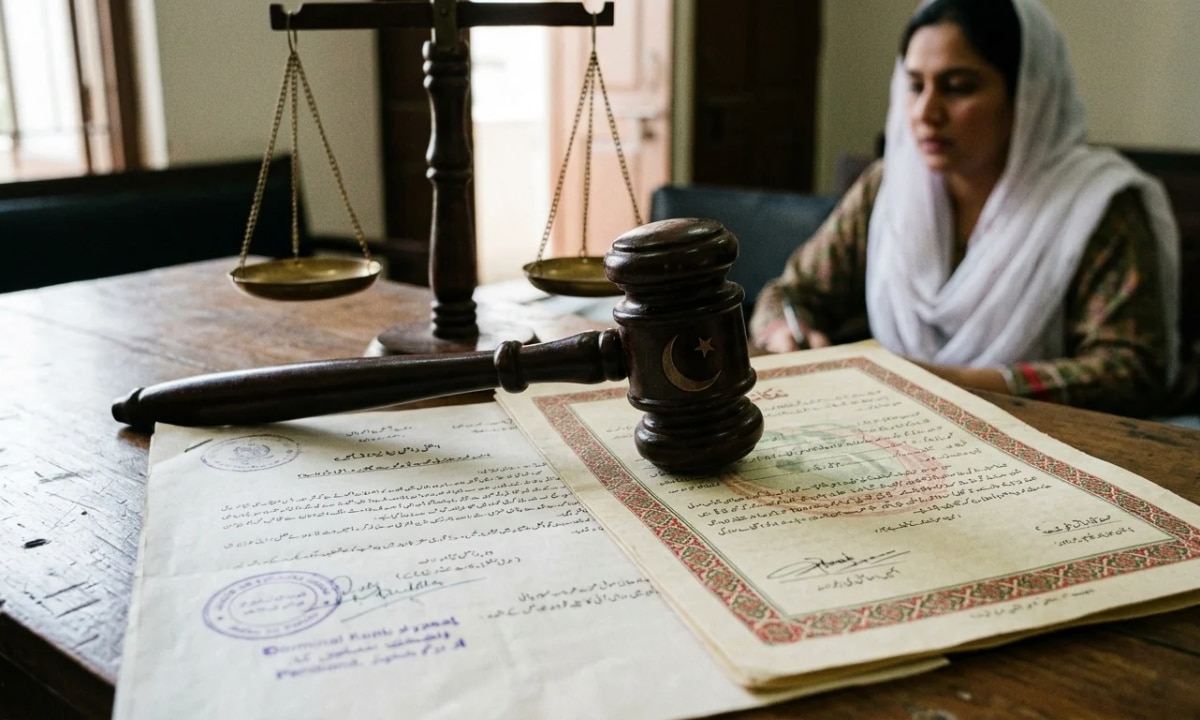
The Supreme Court of Pakistan recently issued a calibrated judgment regarding inheritance rights, resolving a property dispute that spanned over seven decades. Consequently, this ruling clarifies that Sharia and legal rights devolve upon all heirs immediately upon the death of a family head. This structural intervention by Justice Shahid Bilal Hassan ensures that female heirs cannot be deprived of their baseline entitlements through social coercion or fraudulent revenue entries.
Strengthening National Law: Why Inheritance Rights Are Non-Negotiable
Heading a two-judge bench, Justice Hassan set aside a 2017 Lahore High Court judgment that previously failed to protect the claimants. Specifically, the court declared a 1955 mutation involving an alleged verbal gift as illegal, void, and fraudulent. This decision acts as a catalyst for systemic reform within the revenue departments, which often struggle with precision in record-keeping. Furthermore, the court observed that the law of inheritance serves as a divine scheme for wealth distribution and economic justice.

Justice Hassan noted that the right to inherit is not a “bounty” to be granted at the pleasure of male family members. In contrast, it is a vested right that the legal system must protect against customary pressures. Simultaneously, the judgment stressed that when a gift is challenged, the beneficiaries must bear the burden of proof to demonstrate its lawfulness. This shift in legal protocol prevents the systemic marginalization of women within the national property framework.
The Situation Room: Strategic Analysis
The Translation (Clear Context)
Legally, this judgment eliminates the “gray area” often exploited by male relatives through “verbal gifts” (Hiba). Traditionally, family members claimed oral agreements to bypass written records and exclude women. The Supreme Court has now calibrated the law to demand rigorous proof for such claims. Consequently, any transfer of inheritance rights that lacks transparent, verifiable documentation is now highly vulnerable to legal reversal.
The Socio-Economic Impact
This ruling directly impacts the economic stability of households across urban and rural Pakistan. By securing inheritance rights for women, the court is injecting capital into a demographic that is often financially sidelined. For the average Pakistani citizen, this means that ancestral property is no longer a tool for male dominance but a shared asset. Increased financial autonomy for women leads to better educational outcomes for children and higher household resilience against economic shocks.
The Forward Path (Opinion)
This development represents a significant Momentum Shift for Pakistan’s legal landscape. It moves the needle from “customary practice” toward “constitutional precision.” While the judgment is a victory, the forward path requires the revenue authorities to digitize records to prevent future fraud. We view this as a strategic baseline for building a more equitable and efficient economic system.
Actionable Directives for Heirs
- Verify Records: Audit all family revenue entries to ensure no “verbal gifts” have bypassed legal heirs.
- Legal Documentation: Ensure all property transfers are documented through registered deeds rather than informal mutations.
- Assert Rights: Understand that inheritance is triggered immediately upon death; delay in distribution does not diminish the legal claim.









