
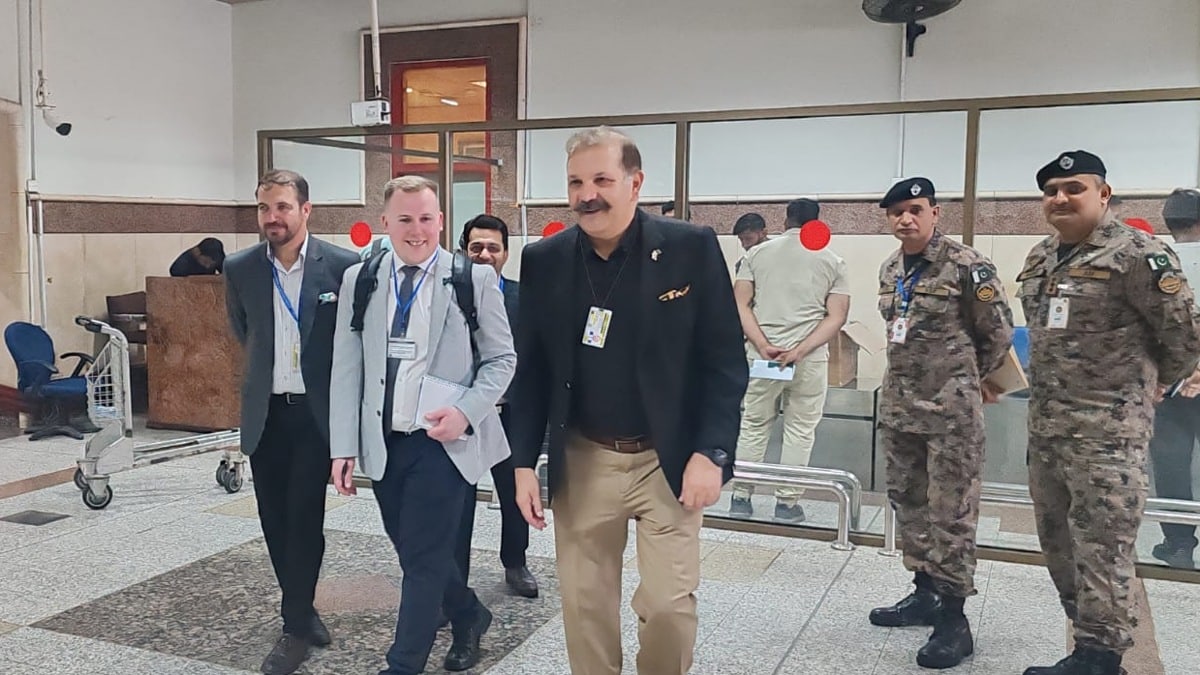
Precision in aviation protocols serves as the baseline for global connectivity and national economic integration. Recently, a two-member team from the United Kingdom’s Department for Transport (DfT) initiated its annual aviation security assessment of Pakistan’s airports, airlines, and security frameworks. The delegation, featuring experts Alexander and Adman, arrived in Lahore this Sunday to evaluate the structural integrity of our civil aviation safety measures.
Calibrating Safety: The Aviation Security Assessment Scope
The UK delegation commenced its rigorous inspection at Lahore Airport on Monday. Consequently, the team will transition to Islamabad International Airport on Wednesday to continue the review. This mission is critical because, while Islamabad receives regular audits, this visit represents the first formal assessment of Lahore Airport by the UK team in nearly five years. The inspection targets the Airport Security Force (ASF) and domestic airlines to ensure compliance with international safety benchmarks.

Air Commodore (Retd.) Shahid Qadir, the Director of Aviation Security and Facilitation, is leading the coordination from the Pakistan Civil Aviation Authority (PCAA). This collaborative effort ensures that national inspectors work in tandem with British officials to identify potential systemic gaps. Upon completion, the DfT will submit a detailed findings report to the PCAA to catalyze necessary technical upgrades.

The Translation: Breaking Down Technical Protocols
This aviation security assessment is not merely a routine check of metal detectors. It is a deep-dive audit into the “Chain of Trust” that governs international travel. The UK DfT evaluates everything from biometric data handling to the physical perimeter security of the ASF. Essentially, they are verifying if Pakistan’s aviation ecosystem can reliably prevent unauthorized access and manage technical threats in real-time. This level of scrutiny is mandatory for maintaining direct flight routes between Pakistan and the United Kingdom.
The Socio-Economic Impact: What This Means for Citizens
For the average Pakistani citizen, these technical audits translate into direct economic benefits. Successful assessments lead to increased confidence from international carriers, which can result in more direct flight options and lower ticket prices for students and professionals. Furthermore, a secure aviation environment acts as a catalyst for global trade. Improved security ratings facilitate smoother cargo logistics, directly supporting exporters who rely on efficient aerial supply chains to reach European markets.
The Forward Path: Momentum Shift
This development represents a significant Momentum Shift for Pakistan’s aviation sector. Reintroducing Lahore into the UK’s annual assessment cycle after a five-year hiatus indicates a restoration of international trust in our provincial hubs. While this is a stabilization move in terms of safety maintenance, the data generated will likely serve as the architectural foundation for future expansions in international air travel agreements. We must now focus on implementing the team’s findings with absolute precision.








