
Structural efficiency within the British housing market requires a calibrated understanding of local governance. For the Pakistani diaspora, the transition involves more than just a geographic shift; it requires a precise alignment with UK planning rules regarding domestic modifications. Specifically, the installation of air conditioning (AC) systems, often a necessity in South Asian climates, can trigger legal enforcement if not strategically managed. Consequently, new residents must evaluate the regulatory landscape before altering their property’s exterior baseline.
The Regulatory Enforcement: A Case Study in Precision
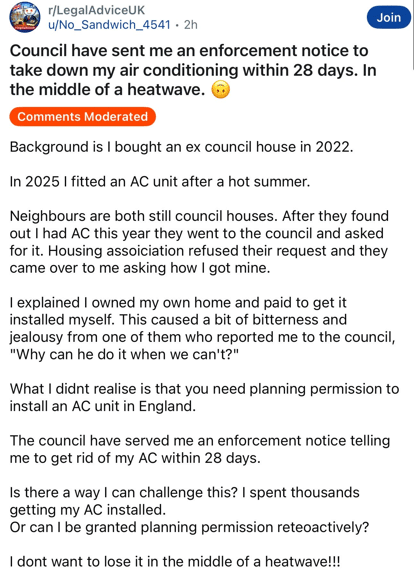
A homeowner in England recently faced a significant setback after failing to observe local architectural constraints. He installed an external air conditioning unit in 2025 following an intense heatwave. However, his local council soon intervened, issuing an enforcement notice that demanded the removal of the system within 28 days. This incident highlights a critical friction point between modern comfort needs and established UK planning rules.
Furthermore, the conflict arose when neighbors, who were denied similar installations by their housing association, reported the unit. This scenario underscores the systemic vigilance present in UK residential zones. The homeowner now faces the complex task of seeking retrospective planning permission, a process that offers no guaranteed stabilization of his current setup.
Decoding Permitted Development Rights
The British government allows many domestic installations under “permitted development rights.” This framework enables homeowners to bypass full planning applications if their project meets specific, calibrated conditions. However, these rights are not universal. Factors such as property location, unit size, and noise levels determine whether your AC installation remains legal or becomes a liability under UK planning rules.
- Property Type: Flats and maisonettes often lack the same rights as detached houses.
- Conservation Areas: Properties in protected zones face much stricter aesthetic and structural oversight.
- Unit Placement: The outdoor condenser’s position must not interfere with the public’s visual or auditory environment.

The “Situation Room” Analysis
The Translation (Clear Context)
In Pakistan, property modification is often a private matter with minimal external oversight. In contrast, the UK operates on a collective architectural standard. “Permitted Development” is a specific legal category, not a general right. If your AC unit exceeds a certain volume (decibels) or protrudes beyond a specified distance from the wall, it legally ceases to be a “minor modification” and becomes an “unauthorized development.” Understanding this logic is the first step toward successful relocation.
The Socio-Economic Impact
For the average Pakistani citizen moving to the UK, an enforcement notice represents a dual financial shock. First, the initial investment in the cooling system (thousands of pounds) is jeopardized. Second, the cost of legal appeals or forced removal adds a heavy burden to household budgets. Beyond finances, the inability to control indoor climates during increasingly frequent European heatwaves impacts the health and productivity of students and professionals alike.
The “Forward Path” (Opinion)
This development represents a Stabilization Move for UK local councils but a hurdle for modern living standards. While preserving architectural heritage is vital, the rising global temperatures necessitate a more agile approach to cooling infrastructure. We advise all “Next Gen” Pakistanis to treat AC installation as a strategic project: always secure a “Lawful Development Certificate” before the first bolt is drilled. Precision in paperwork is as important as the precision of the cooling unit itself.








