
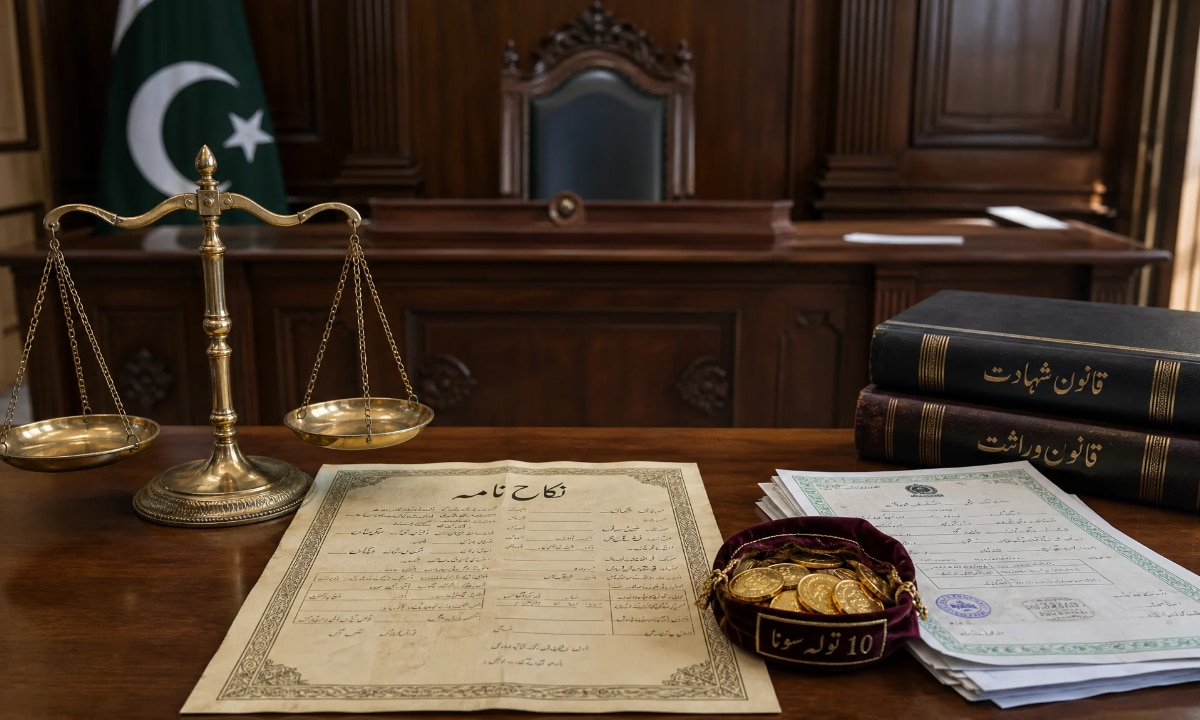
Precision in family law acts as a strategic catalyst for national social stability. The Lahore High Court (LHC) recently established a definitive precedent regarding Haq Mehr Rights, ruling that a woman’s entitlement to her marital gift remains intact regardless of marriage consummation or cohabitation. Justice Mirza Waqas Rauf clarified that this right is anchored in the Nikah Nama contract itself, rather than the physical status of the union. Consequently, this judgment recalibrates how subordinate courts must interpret marital financial obligations.
Why Haq Mehr Rights Survive Separation
The court issued this landmark nine-page written verdict following a petition by Azka Afreen. Justice Rauf specified that if a Nikah Nama does not explicitly define a delayed timeframe for the Mehr, the law considers it “prompt” (Mu’ajjal). Furthermore, the husband must pay this amount in full whenever the wife demands it. In the specific case of Afreen, the court deemed the following assets immediately payable:
- 10 tolas of gold
- One kanal of land
- A residential house
Because the contract lacked deferred payment conditions, the husband cannot legally withhold these assets. The LHC corrected previous errors made by lower courts to ensure these Haq Mehr Rights were fully enforced.
New Ratio for Khula Terminations
The judgment also established a calibrated ratio for asset returns during Khula. When a woman seeks to terminate a marriage via Khula, she must legally return 25% of the Haq Mehr to her husband. Consequently, the marriage is considered terminated immediately upon the return of this specific portion. This structural clarity eliminates previous ambiguities regarding financial settlements during separation.
The Situation Room Analysis
The Translation
Technically, the LHC has shifted the interpretation of Haq Mehr from a “contingent gift” to a “vested contractual right.” In simpler terms, the moment a Nikah is signed, the debt is created. Unless the contract specifically says “pay later,” the law assumes “pay now.” Furthermore, the ruling simplifies the “exit price” of a marriage by setting the Khula return rate at a fixed 25%, removing the leverage often used to stall legal separations.
The Socio-Economic Impact
This development significantly enhances the financial baseline for Pakistani women, particularly those in vulnerable urban and rural households. By ensuring that gold and land titles remain with the woman regardless of cohabitation, the court prevents the weaponization of financial withholding. Consequently, this provides a safety net that allows women to exit non-functional marriages without facing immediate destitution.
The Forward Path
This ruling represents a significant Momentum Shift in Pakistan’s legal landscape. It moves the system toward a more disciplined, contract-focused framework. By enforcing the Nikah Nama as a binding document rather than a ceremonial formality, the LHC is driving the judiciary toward higher systemic efficiency and gender-inclusive justice.








