
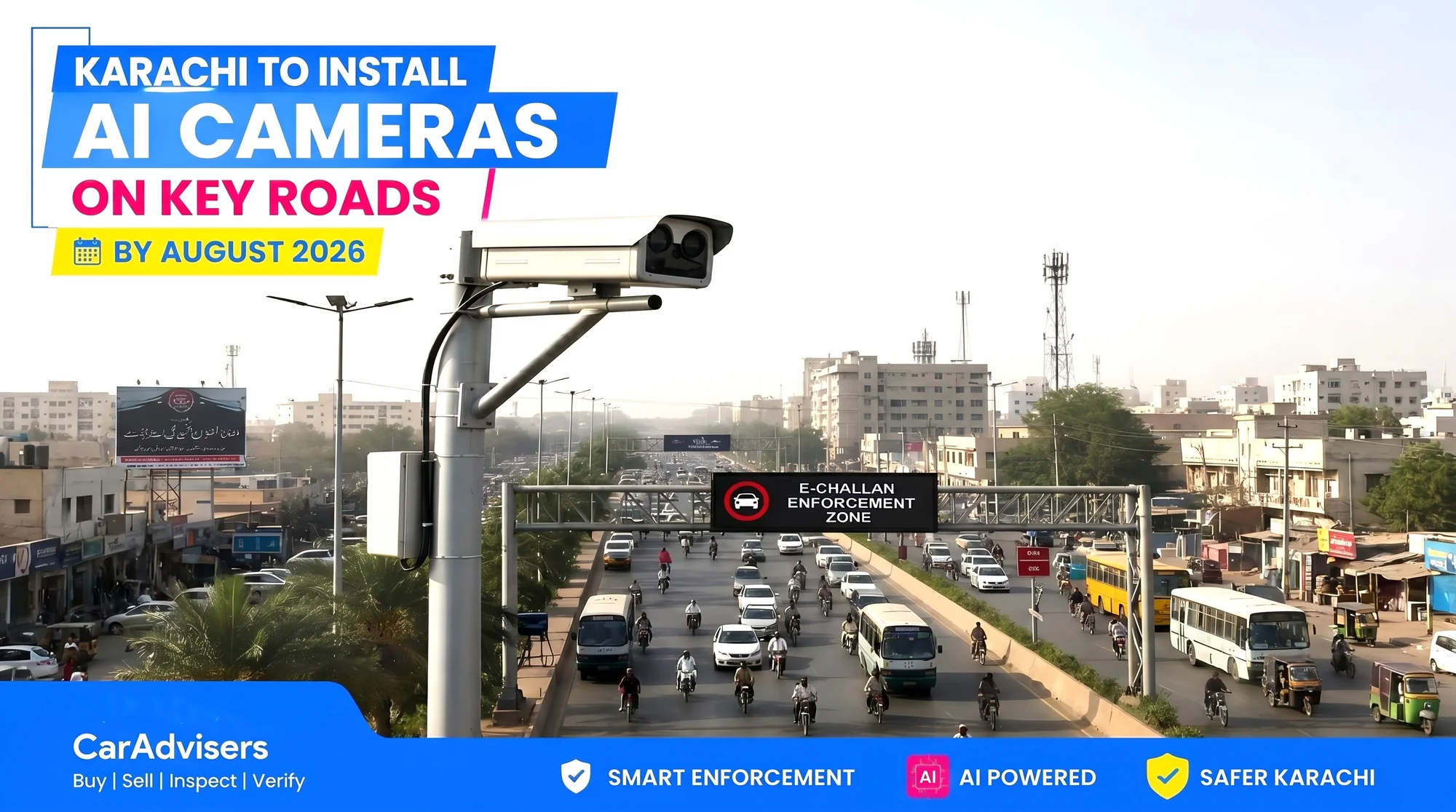
Urban mobility requires calibrated infrastructure to sustain growth. Consequently, the Karachi Traffic Police is deploying AI traffic cameras to transition from reactive policing to automated, precision-based enforcement across the city’s critical arteries. This strategic expansion targets a total system integration by August 2026, focusing on Airport Road, Clifton, and the pivotal junctions of Do Talwar and Teen Talwar.
Scaling the Network: Why AI Traffic Cameras are the New Baseline
DIG Traffic Pir Muhammad Shah confirmed that the system is currently undergoing rigorous testing on Shahrah-e-Faisal. Engineers have already deployed 20 high-resolution Automatic Number Plate Recognition (ANPR) cameras reaching as far as Drigh Road. These units operate continuously, providing a 24/7 surveillance baseline that detects lane violations with surgical accuracy.
The authorities selected Shahrah-e-Faisal as the pilot site due to its immense traffic density. Currently, the system generates approximately 100 electronic tickets (challans) daily. Furthermore, the DIG emphasized that establishing discipline on the city’s busiest artery serves as a catalyst for reform across the entire metropolitan road network.
A Calibrated Penalty Framework
The new enforcement model utilizes a tiered fine structure designed to reflect the risk levels associated with different vehicle classes. The authorities have explicitly stated that no first-offense waivers exist on monitored routes, although they do permit a one-time deferment for administrative flexibility.
- Motorcycles and Rickshaws: Rs. 2,500
- Private Motor Cars: Rs. 5,000
- Buses and Commercial Transport: Rs. 7,500
- Heavy Vehicles (Dumpers/Tankers): Rs. 10,000
Crucially, the AI traffic cameras distinguish between intentional violations and genuine emergencies. The system flags incidents involving mechanical breakdowns or road hazards for manual review by human officers, ensuring that the technology remains fair and contextual.
The Translation: Contextualizing AI Enforcement
This initiative moves beyond “smart” cameras; it represents a shift toward algorithmic governance. By removing human discretion from initial detection, the system eliminates bias and ensures that every lane violation is logged. This technology “learns” traffic patterns, allowing the department to optimize traffic light timings based on real-time congestion data captured by the ANPR sensors.

Socio-Economic Impact: Precision on the Pavement
For the average Pakistani citizen, this system reduces the “hidden tax” of traffic congestion—lost time and fuel. Disciplined lane usage directly correlates with faster commute times for professionals and students. Additionally, by forcing heavy vehicles like tankers and buses into designated lanes, the risk of fatal accidents on high-speed corridors decreases significantly, potentially lowering insurance and healthcare costs for urban households.
The Forward Path: A Momentum Shift
This development represents a significant Momentum Shift for Karachi. While infrastructure projects often focus on physical asphalt, this digital layer provides the structural discipline necessary for a modern economy. If the August 2026 deadline is met for the expanded rollout, Karachi will establish a technological baseline that other Pakistani megacities must follow to achieve systemic efficiency.