
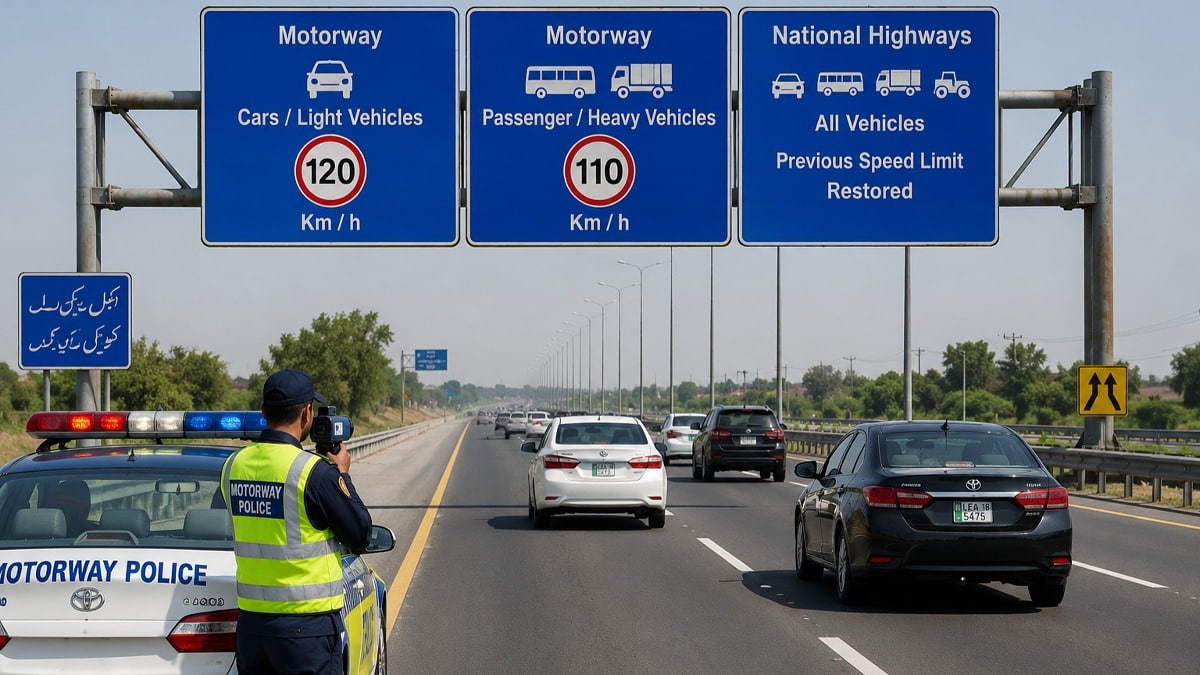
The National Highways and Motorway Police (NHMP) has officially restored the original Motorway speed limits for all vehicle categories across the country. This structural reversal terminates the temporary reduction previously enforced on major transport arteries. Consequently, light vehicles like cars can now maintain a calibrated pace of 120 km/h. Meanwhile, heavy transport vehicles (HTV) and passenger buses will operate at a precision baseline of 110 km/h. This strategic adjustment aims to synchronize travel efficiency with existing road safety protocols across the national network.
Calibrating Pakistan’s Logistical Flow
Syed Imran Ahmed, the Motorway Police spokesperson, confirmed that the government withdrew its earlier decision to lower speeds. The NHMP designed this restoration to facilitate road users and reduce travel times between urban hubs. Furthermore, authorities reinstated the original speed caps for national highways, ensuring a uniform transition back to standard operational procedures. Despite these increased limits, the spokesperson emphasized that public safety remains the highest priority for the department.

The NHMP continues to urge motorists to exercise caution. Drivers must wear seat belts and maintain precise control over their vehicles at these higher velocities. Strict adherence to traffic regulations is mandatory to prevent structural failures in road safety during this transition period.
The Translation: Next Gen Clarity
In technical terms, this move shifts the motorway network from a “restricted flow” state back to “optimal throughput.” The previous reduction served as a temporary stabilizer, likely due to environmental or safety audits. By returning to the 120 km/h baseline for light vehicles, the system acknowledges that modern vehicle safety tech and road surfacing can handle higher kinetic energy levels. The NHMP is essentially betting on driver discipline to maintain system equilibrium.

The Socio-Economic Impact
This decision directly impacts the daily lives of millions of Pakistanis. For the professional commuter, it translates to a 10-15% reduction in transit time between cities like Lahore and Islamabad. For the logistics sector, the 110 km/h allowance for heavy vehicles ensures that supply chains remain agile, reducing the cost of transport for essential goods. Ultimately, faster travel promotes greater economic connectivity between rural producers and urban consumers.
The Forward Path: Strategic Momentum
This development represents a Momentum Shift for Pakistan’s infrastructure. While maintaining safety is critical, the restoration of Motorway speed limits signals a move toward high-efficiency transport logic. To sustain this progress, the next phase must involve the integration of AI-driven speed monitoring and automated lane enforcement. Precision in speed must be matched by precision in compliance to ensure our motorways remain the safest corridors in the region.








