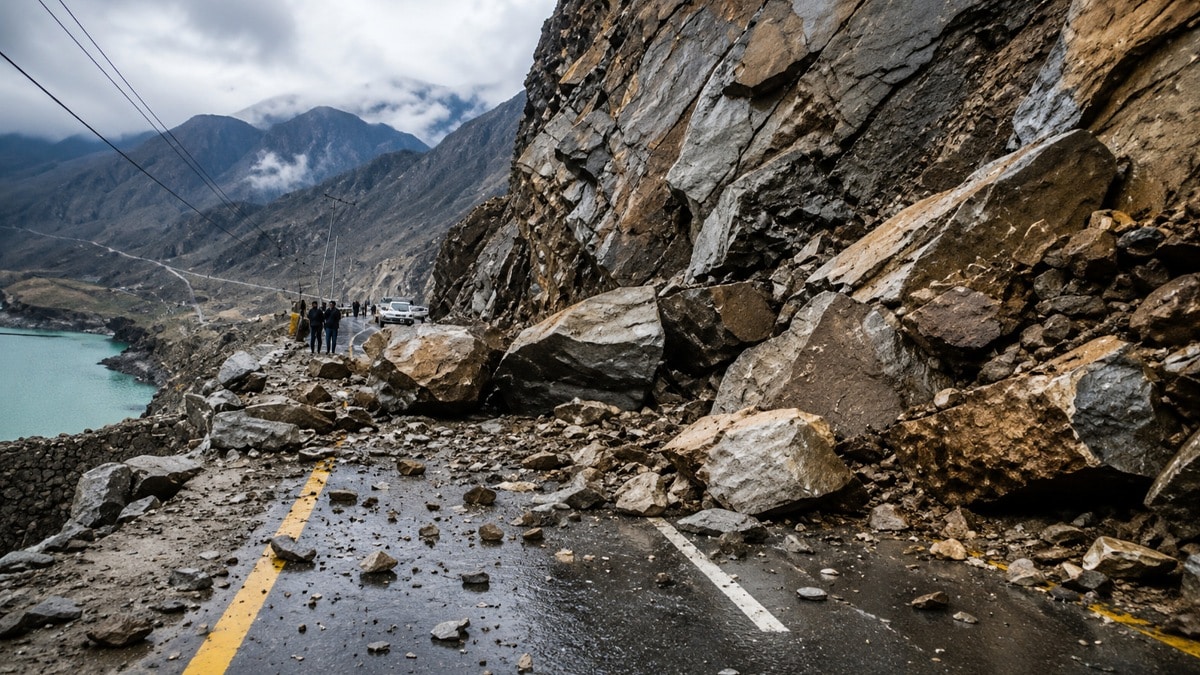
Heavy precipitation has catalyzed a series of geological shifts, as landslides block roads across critical sectors of Gilgit-Baltistan, effectively severing the region’s primary transport arteries. On Wednesday, intense mudflows obstructed the Karakoram Highway at multiple coordinates between Gunar Farm and Lal Padi in the Chilas area of Diamer. Consequently, this structural failure has stranded a vast number of travelers and disrupted the flow of essential goods.
Systemic Disruptions on the Karakoram Highway
The Gilgit-Baltistan Disaster Management Authority (GBDMA) confirmed that falling debris hit several high-traffic locations. Currently, the National Highway Authority (NHA) is executing debris removal operations to restore the baseline connectivity of the highway. However, the sheer volume of mud and rock has created long queues of vehicles on both sides of the corridor, stalling movement to and from the northern territories.

Baltistan Road and Regional Isolation
Furthermore, the disruption extends beyond the main highway. Landslides near Maloopa in the Roundu area of Skardu have blocked the Baltistan Road. Passengers traveling to and from Baltistan faced several hours of isolation as authorities calibrated their response. The National Disaster Management Authority (NDMA) has issued a calibrated warning, predicting possible flooding and further landslide risks across Punjab, Khyber Pakhtunkhwa, and Balochistan between June 16 and June 19.
The Translation: Geological Precision
While we often view these events as mere “bad weather,” the logic behind these closures is rooted in the geological instability of the Hindu Kush-Himalayan region. Heavy rains act as a catalyst, saturating the soil and decreasing the structural friction that holds mountain slopes together. When landslides block roads, it is not just a weather event; it is a manifestation of the ongoing struggle between regional infrastructure and environmental dynamics.
Socio-Economic Impact: The Daily Reality
The closure of these roads exerts immediate pressure on the daily lives of Pakistani citizens. We observe the following impacts:
- Supply Chain Volatility: Interrupted transport leads to a surge in prices for fresh produce and fuel in Gilgit and Skardu.
- Tourism Disruption: Stranded travelers face safety risks, while the local hospitality industry suffers from sudden cancellations.
- Academic and Professional Delays: Students and professionals moving between the north and urban centers like Islamabad face indefinite delays, impacting productivity.
The Forward Path: Architectural Resilience
This development represents a Stabilization Move rather than a momentum shift. While the NHA and GBDMA show precision in their clearance operations, the recurring nature of these blockages highlights a need for structural evolution. Pakistan must transition from reactive clearing to proactive stabilization. Investing in “smart” slope monitoring and bio-engineering for soil retention will be the catalyst for a more resilient northern corridor.