
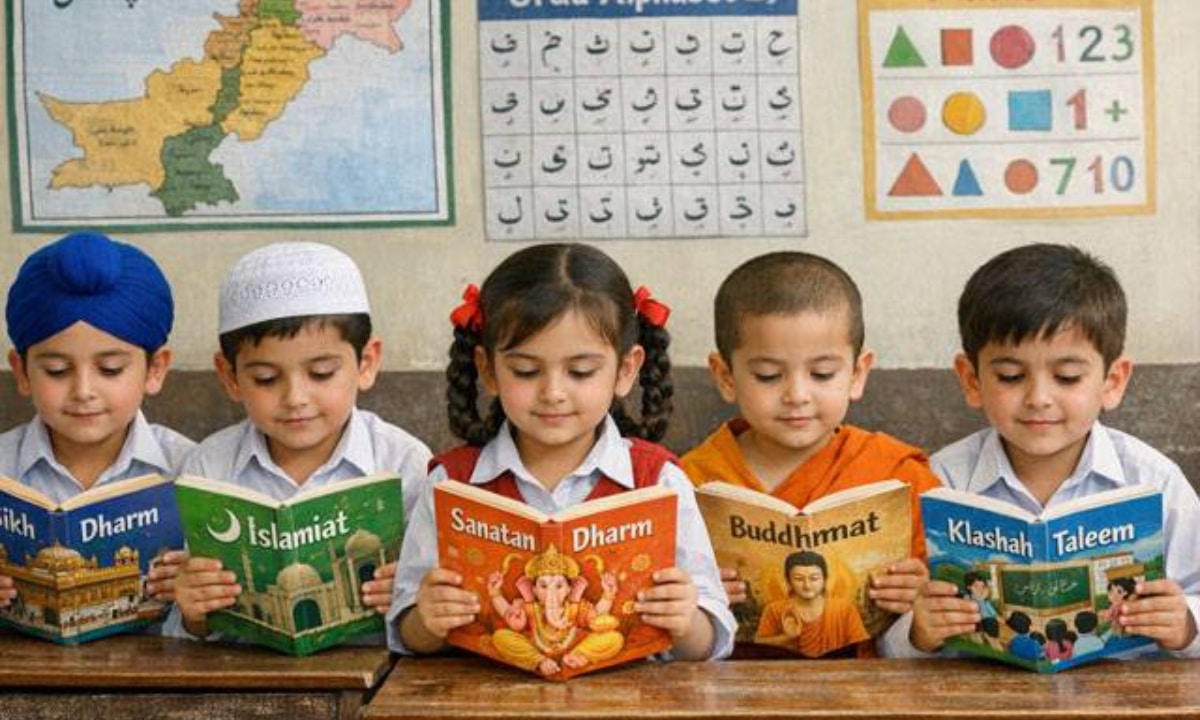
Punjab has calibrated its educational framework by approving an inclusive religious curriculum for non-Muslim students, representing a structural shift toward national cohesion. The Punjab Curriculum and Textbook Authority (PCTB) formalized this move to ensure that academic content aligns with the diverse belief systems of the province’s citizens. Consequently, this initiative establishes a precision-based baseline for minority representation in the public education system.
Strategic Implementation of the Inclusive Religious Curriculum
The PCTB notified the introduction of faith-specific textbooks starting from the 2026–27 academic session. Under this policy, the state will provide Christian students in Grades 1 to 9 and Grade 11 with dedicated “Christian Education” subjects. Hindu students in Grades 1 to 3 will transition to “Sanatan Dharma” textbooks, while Sikh students will engage with the “Sikh Dharma” curriculum. Furthermore, the provincial government has introduced specialized “Kalasha Education” for the Kalasha community, marking a historic first for the region.
In addition to these changes, Buddhist students in Grades 1 to 3 will study “Buddhism” textbooks. Zoroastrian students will follow a tailored “Zoroastrianism” curriculum from Grade 1 through Grade 5. These strategic adjustments aim to replace generic ethics courses with faith-accurate instruction. By doing so, the authority strengthens the structural integrity of the provincial education mandate.
The Translation: Contextualizing the Reform
This development signifies more than just a change in textbooks; it is a recalibration of the “Ethics” subject model. Previously, non-Muslim students often studied a generalized ethics course that lacked specific theological depth. The new inclusive religious curriculum decentralizes religious instruction. This move allows students to engage with their ancestral heritage through formalized, state-vetted materials, ensuring intellectual and spiritual precision within the classroom.
The Socio-Economic Impact
How does this change the daily life of a Pakistani citizen? For minority households, this policy reduces the “identity friction” often felt in standardized schooling. Students from urban centers to rural districts will now see their beliefs validated by the state apparatus. This validation acts as a catalyst for social mobility, as inclusive environments typically correlate with higher retention rates and better psychological outcomes for minority students. It effectively integrates these communities into the national narrative without demanding the erasure of their distinct identities.
The Forward Path: Strategic Analysis
In my assessment, this development represents a significant Momentum Shift for Pakistan’s educational landscape. While the 2026–27 timeline requires disciplined logistics, the policy itself serves as a stabilizer for social harmony. To maximize efficiency, the government must now focus on the precision-training of teachers specialized in these diverse curricula. If executed correctly, this reform will serve as a global benchmark for pluralistic education in multi-faith societies.








