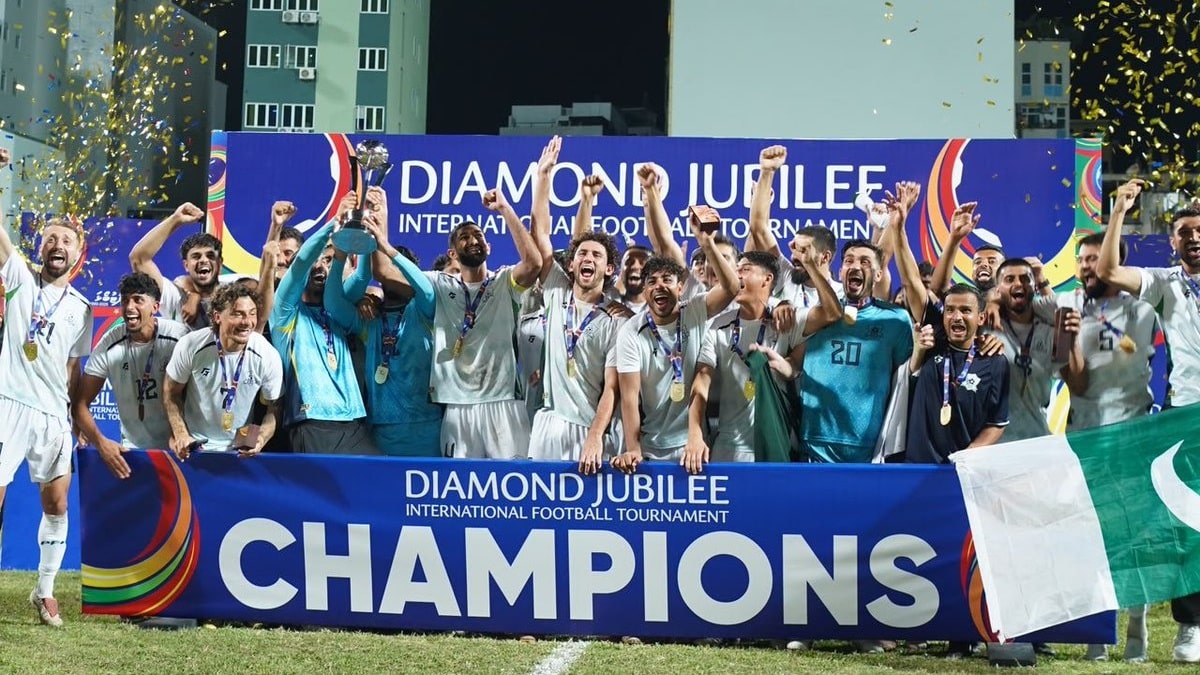
Pakistan ended a seven-decade drought by securing a major Pakistan football title after defeating Afghanistan 2–0 in the Diamond Jubilee International Football Tournament final. This historic victory at the National Stadium marks the first stand-alone international crown for the men’s national team. Consequently, the Shaheens have established a new performance baseline for the sport within the country.
Strategic Execution Secures the Pakistan Football Title
The match began with high intensity as Afghanistan tested the Pakistani defense early in the first half. However, the Shaheens gradually gained control through disciplined tactical positioning and precise wing play. Shayek Dost eventually broke the deadlock in the 24th minute with a calibrated overhead kick. This acrobatic finish followed a failed clearance from the Afghan defense, sending the home crowd into a frenzy. Furthermore, Otis Khan provided a constant attacking threat from the left flank, acting as a catalyst for Pakistan’s forward momentum.
Pakistan maintained defensive integrity throughout the second half despite increasing pressure from the opposition. Goalkeeper Saqib Hanif organized the back line with precision, ensuring the team remained compact. Later, substitute Harun Hamid sealed the victory in stoppage time. Hamid outmaneuvered his marker with a sharp turn and finished clinicaly past the Afghan goalkeeper. This result confirmed Pakistan’s unbeaten status throughout the competition, reflecting a significant leap in system efficiency.
The Translation: Beyond the Scoreboard
This victory represents a structural evolution rather than a mere statistical anomaly. Under the guidance of head coach Norberto Solano, the team has transitioned from a defensive posture to a more balanced, possession-based framework. The Pakistan football title serves as empirical evidence that professional coaching and consistent match minutes yield measurable progress. By integrating overseas talent with domestic players, the PFF has created a more competitive and resilient national unit.
The Socio-Economic Impact: A New Path for Youth
For the average Pakistani citizen, this win transforms football from a hobby into a viable professional pathway. Success on the international stage attracts corporate sponsorship and infrastructure investment, which eventually trickles down to grassroots academies. Consequently, young athletes in both urban centers and rural districts now have a tangible baseline for success. This achievement fosters national unity and provides a powerful alternative to the traditional cricket-centric sports culture.
The Forward Path: Momentum Shift
We classify this development as a definitive Momentum Shift. While the win is celebratory, its true value lies in the preparation it provides for next year’s Asian Cup and World Cup qualifying campaigns. To sustain this trajectory, the football federation must now focus on technical consistency and long-term structural investment. This title is not the finish line; it is the catalyst for a future where Pakistan competes regularly at the highest echelons of Asian football.