
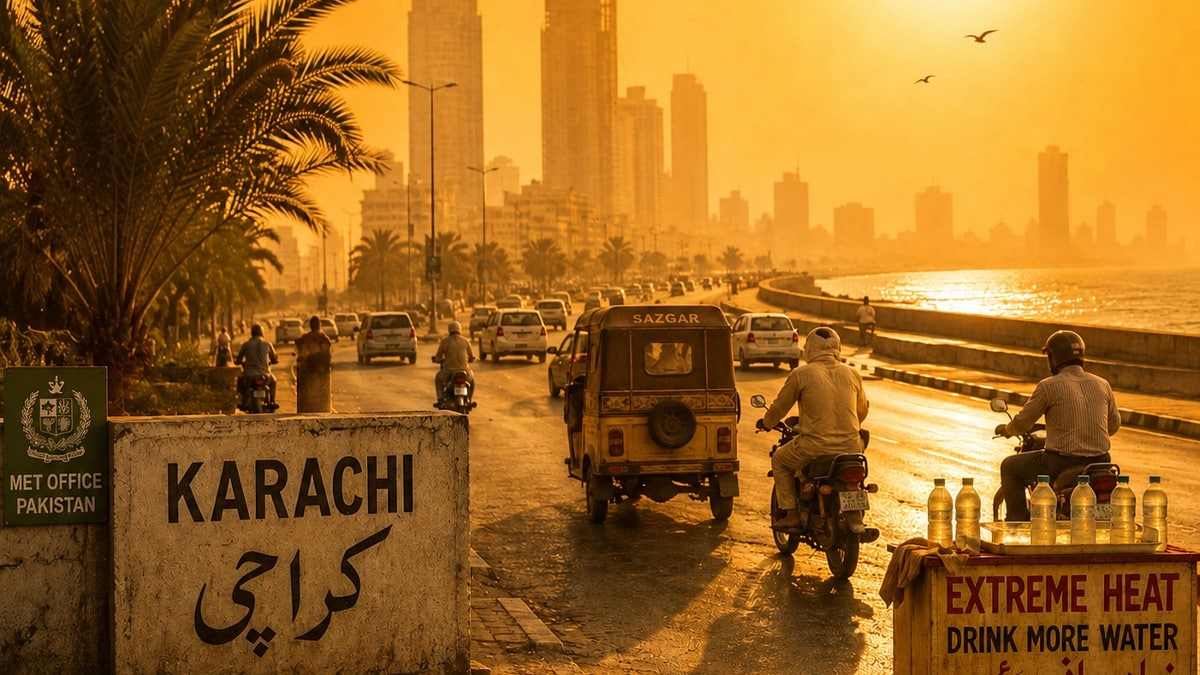
Precision data indicates a calibrated shift in the local climatic baseline. While the mercury registered 36.5°C on Tuesday, the Karachi heat index surged to a critical 48°C due to an aggressive 62 percent humidity level. Consequently, the atmospheric discomfort reached levels far beyond the raw temperature readings, posing a significant challenge to the city’s operational efficiency.
Decoding the Karachi Heat Index Surge
The Pakistan Meteorological Department (PMD) monitored the peak conditions at 2:00 PM, where southwest winds blowing at 21 kilometers per hour failed to provide relief. Specifically, the interplay between 36°C actual heat and 60 percent humidity acted as a catalyst for the 48°C “feels-like” sensation. Furthermore, upper and central Sindh experienced even more extreme baseline temperatures, with Dadu peaking at 48°C.

Forecasts for Wednesday suggest no immediate stabilization. Meteorologists predict humidity levels could exceed 70 percent, potentially maintaining the Karachi heat index at dangerous thresholds despite a consistent actual temperature of 36°C. Regions like Sukkur and Rohri continue to record actual temperatures near 46.5°C, confirming a province-wide thermal crisis.
The Translation: Technical Context
In technical terms, the “feels-like” temperature is a calibrated metric known as the Heat Index. It calculates how heat is perceived by the human body when relative humidity is combined with the air temperature. When humidity is high, the body’s primary cooling mechanism—sweat evaporation—is inhibited. Therefore, the Karachi heat index provides a more accurate assessment of physiological stress than the thermometer alone.
The Socio-Economic Impact
This thermal surge exerts structural pressure on Pakistan’s economic engine. High humidity levels combined with extreme heat lead to a sharp decline in labor productivity, particularly for outdoor workforce sectors. Urban households face increased energy demand, straining the power grid and inflating utility costs. For the average citizen, this translates to heightened health risks and a baseline reduction in daily operational capacity.
The Forward Path: Strategic Opinion
This development represents a Stabilization Move in the short term, but it signals a long-term necessity for a Momentum Shift in urban planning. We must transition from reactive cooling to structural resilience. Investing in “cool-roof” technologies and expanding urban green canopies is no longer optional; it is a strategic requirement for maintaining the viability of our coastal metropolises.








