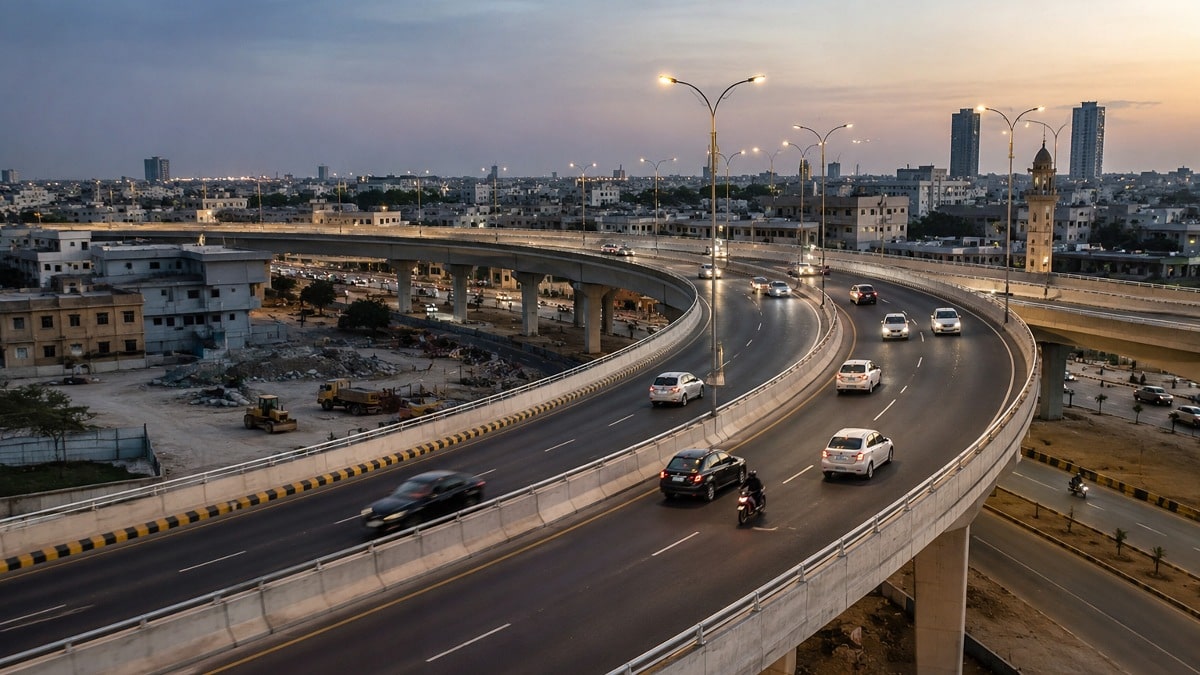
Efficient urban mobility serves as the skeletal framework for a high-functioning economy. Karachi Mayor Barrister Murtaza Wahab recently announced that the Azeempura Flyover Karachi project has reached completion and will open to traffic within the next week. This Rs. 1.47 billion infrastructure initiative successfully met the 100-day completion target established by Sindh Chief Minister Syed Murad Ali Shah. Consequently, the main structure is now fully calibrated, with engineers currently executing the final finishing phases.
Strategic Connectivity and Urban Precision
The Azeempura Flyover Karachi serves as a critical link between Shahrah-e-Bhutto and Jinnah International Airport. By facilitating a direct corridor, the Karachi Metropolitan Corporation aims to mitigate chronic traffic congestion and significantly reduce travel times for airport-bound motorists. This development reflects a strategic approach to addressing the city’s expanding logistical requirements. Furthermore, the project underscores a commitment to high-density infrastructure within the city’s most volatile transit zones.
- Reduced Travel Latency: Direct access between major arterial roads and the international airport.
- Economic Efficiency: Lower fuel consumption for commercial and private commuters.
- Structural Accountability: Completion within a strict 100-day performance window.
The Translation: Contextualizing the 100-Day Metric
In the context of urban engineering, the “100-day target” is more than a deadline; it is a baseline for administrative throughput. By adhering to this timeline, the Sindh government demonstrates a pivot toward precision project management. This shift suggests that the historical delays typically associated with Karachi’s public works are being replaced by a more disciplined, results-oriented framework.
The Socio-Economic Impact: Daily Life in Karachi
How does the Azeempura Flyover Karachi change the life of the average citizen? For professionals and families in the Malir and Shah Faisal regions, this translates to reclaimed time. Strategic infrastructure reduces the “hidden tax” of traffic congestion—lost productivity and increased vehicle maintenance costs. By smoothing the transit path to Jinnah International Airport, the flyover also enhances the first impression of the city for international investors and visitors, potentially acting as a catalyst for localized commerce.
The Forward Path: An Expert Assessment
We classify this development as a Momentum Shift. While a single flyover cannot resolve the entirety of Karachi’s complex transit landscape, the speed and execution of the Azeempura Flyover Karachi signal a new standard for urban intervention. If this level of structural discipline is applied to the broader master plan, the city’s transit system will transition from a state of maintenance to a state of expansion.