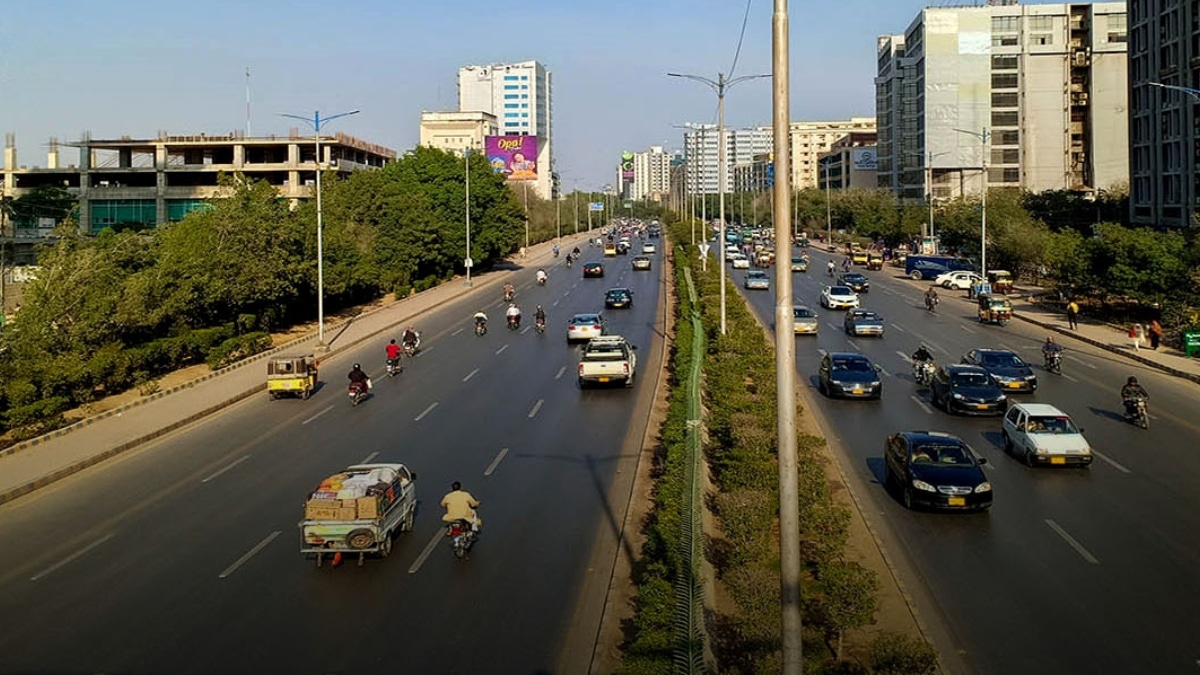
The structural evolution of Karachi’s urban corridors reached a calibrated milestone today as authorities deployed the Karachi e-challan system. Effectively immediately, traffic police began issuing automated fines for lane violations on Shahrah-e-Faisal. This initiative serves as a strategic baseline for improving traffic discipline across one of the city’s highest-density arteries. Consequently, the move signals a transition toward a precision-led monitoring framework for metropolitan mobility.
Precision Enforcement: The Karachi E-Challan System
Traffic police officials confirmed that the system currently focuses exclusively on Shahrah-e-Faisal during this initial phase. However, the government intends to scale this infrastructure to other major thoroughfares in the near future. The spokesperson emphasized that drivers must maintain designated lanes to ensure systemic efficiency. Furthermore, motorcycles, rickshaws, and heavy vehicles now face strict digital surveillance to prevent the chaos often associated with irregular lane switching.
Authorities recently concluded an extensive awareness campaign to prepare the public for this transition. They believe that commuters must now demonstrate greater responsibility to complement these technological upgrades. Historically, lane indiscipline has acted as a primary catalyst for urban congestion and avoidable accidents. Therefore, these measures provide a necessary mechanism to streamline traffic flow and enhance public safety metrics.
System Calibration and Penalties
The lane management plan, finalized last month, restricts bikes, rickshaws, and buses to specific corridors. Authorities prioritized Shahrah-e-Faisal because the existing camera-based infrastructure allowed for immediate integration. Under this calibrated fine structure, the penalties are significant:
- Motorcycles and Rickshaws: Rs. 2,500 fine per violation.
- Buses and Heavy Vehicles: Rs. 7,500 fine per violation.
- Light Transport Vehicles (LTV): Monitored for strict lane adherence.
The Translation: Digital Policing
This development represents a shift from manual, subjective policing to objective, vision-based enforcement. By utilizing pre-existing camera networks, the Karachi e-challan system removes human bias from the citation process. It translates visual data into legal accountability, ensuring that traffic rules are not merely suggestions but enforceable standards. This technological integration serves as the architecture for a smarter, more disciplined urban environment.
The Socio-Economic Impact: Safer Commutes
For the average Pakistani citizen, this system promises a reduction in daily commute times and a decrease in minor road-side collisions. Students and professionals using Shahrah-e-Faisal will encounter a more predictable traffic flow. Economically, the reduction in traffic-related delays improves logistics and fuel efficiency for households and businesses alike. Ultimately, it fosters a culture of lawfulness that is essential for any modernizing economy.
The Forward Path: A Momentum Shift
In our expert view, this launch represents a Momentum Shift. It is not merely a stabilization move; rather, it is a proactive step toward a Smart City framework. While the high fine amounts may seem steep, they are calibrated to act as a genuine deterrent against habitual negligence. If expanded successfully, this digital oversight could redefine the baseline of civil discipline in Pakistan’s largest metropolis.