

National progress depends on the strategic mastery of our natural resources. Engineers from Stanford and MIT have recently calibrated a high-performance solar-powered hydrogel that extracts moisture from arid air to produce clean, drinkable water. Consequently, this development addresses a critical baseline for global health, as 2.1 billion people currently lack access to safely managed hydration sources.
The Translation: Precision Engineering Behind the Hydration
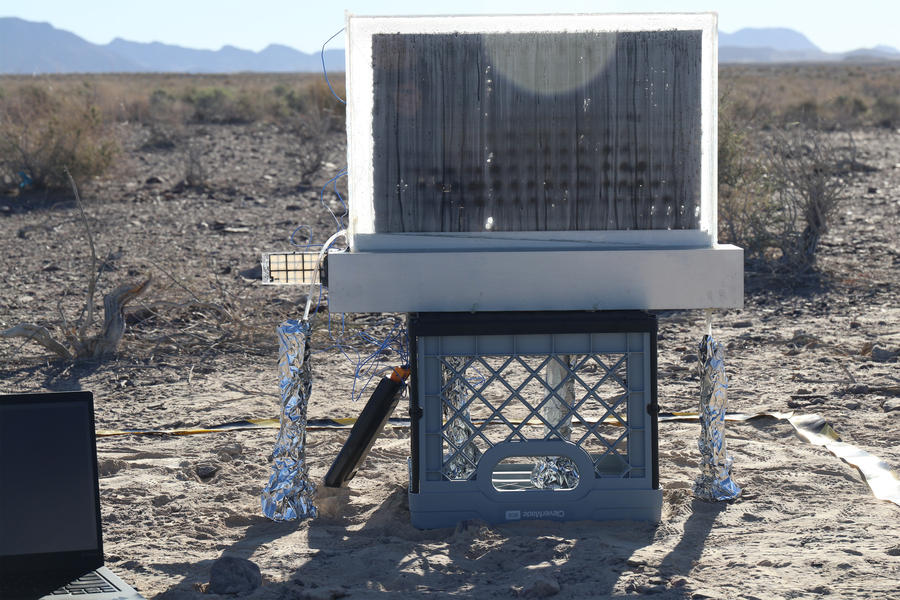
The system utilizes a sophisticated composite of lithium chloride and polyacrylamide. Lithium chloride serves as a highly efficient salt that captures vapor, while polyacrylamide provides the structural polymer matrix. When sunlight strikes the solar-powered hydrogel, it triggers a release of trapped moisture. This vapor then undergoes condensation to become purified water. Specifically, testing in the Atacama Desert demonstrated that black-painted aluminum sheets can catalyze this thermal reaction effectively.
Optimizing Water Harvesting Cycles Through Durability
Initial iterations of the technology suffered from structural breakdown after only 30 cycles. Researchers identified that metal ions from the mounting surface were creating damaging radicals within the gel. To resolve this, the team applied a strategic anti-corrosion coating to the metal interface. This modification shielded the polymer chains and extended the lifespan of the solar-powered hydrogel to over 190 water harvesting cycles during rigorous testing.
Economic Efficiency and Scalability
This structural enhancement reduces the projected cost of water production to approximately $0.01 per liter. This figure represents a 99% cost reduction compared to bottled water, aligning it closely with municipal tap water costs. Currently, a towel-sized panel can generate two liters per day, which meets the emergency survival baseline for a single individual.
:max_bytes(150000):strip_icc()/Solar-Powered-Hydrogel-Drinking-Water-FT-DGTL0526-5b71a86057ae4fe381b9bd6b4a2b08af.jpg)
The Socio-Economic Impact: A Catalyst for Pakistani Prosperity
For a nation like Pakistan, where regions such as Thar and Cholistan face chronic water scarcity, this technology is a systemic game-changer. It empowers rural households to bypass failing infrastructure and generate their own supply. Furthermore, the ability to produce water at $0.01 per liter enables low-income families to reallocate their financial resources toward education and nutrition. By decentralizing water production, we reduce the burden on our national grid and enhance the resilience of our most vulnerable communities.
The Forward Path: A Momentum Shift in Resource Management
The transition from lab-scale prototypes to five-liter-per-day targets represents a significant “Momentum Shift” for sustainable development. While the technology requires further refinement for mass deployment, the durability breakthrough establishes the necessary technical foundation. We view this as a precision catalyst that will eventually transform how arid regions maintain their baseline hydration. It is not merely an update; it is a structural evolution in resource acquisition.








