
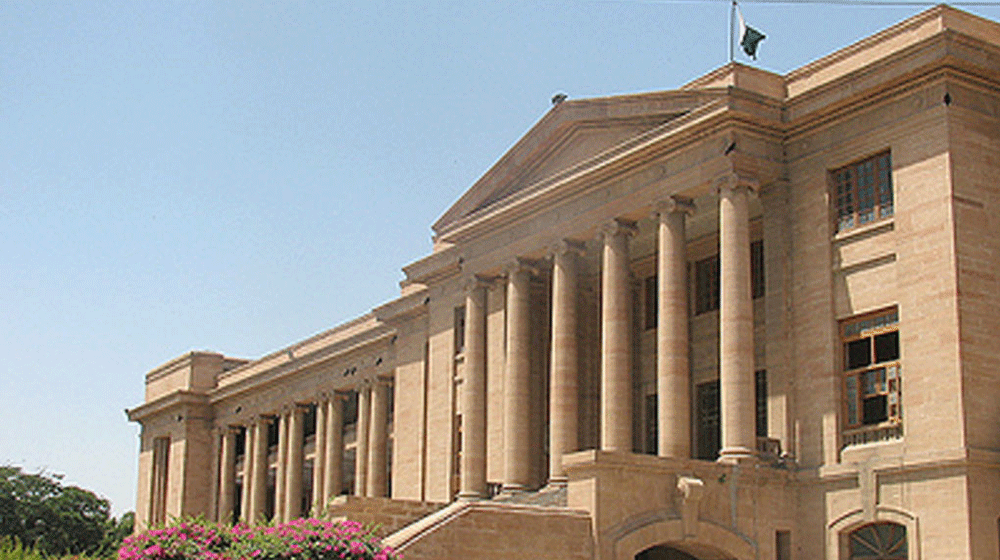
The integrity of national meritocratic systems serves as the fundamental baseline for administrative efficiency. Consequently, the Sindh High Court (SHC) recently acted as a structural catalyst for transparency by ordering that the SPSC results suspended until further notice. This judicial intervention follows significant concerns regarding the fairness of the Combined Competitive Examination (CCE) 2024, which is a critical gateway for provincial governance roles.
Judicial Oversight and the Suspension of CCE 2024 Outcomes
A calibrated two-member bench in Karachi, featuring Justice Muhammad Saleem Jessar and Justice Nisar Ahmed Bhanbro, presided over the hearing. The bench issued a strategic order on Thursday, summoning officials from the Sindh Public Service Commission (SPSC) to present a comprehensive examination record. Furthermore, the court directed the commission to seal and preserve all physical and digital documentation associated with the CCE-2024 cycle to prevent any unauthorized data alteration.
The court initiated this action after seven candidates filed a formal petition challenging the merit-based selection of the 70 successful individuals announced on May 6. These petitioners alleged that the selection process lacked the necessary precision and fairness. Specifically, they claimed that candidates with superior performance metrics were excluded while less qualified individuals were advanced. Consequently, the court barred any subsequent administrative actions based on the contested results.
The Structural Timeline of SPSC Irregularities
The SPSC originally advertised these professional posts in December 2023. Following a screening test in late 2023, the commission conducted written examinations across Karachi, Hyderabad, Sukkur, and Larkana. When the results emerged on May 6, 2024, displaying scores between 500 and 610, the lack of transparency triggered immediate public unrest. This friction escalated when the SPSC registered FIRs against peaceful demonstrators and social media vloggers who questioned the system’s baseline credibility.
The Translation: Contextualizing Systemic Friction
In technical terms, this judicial stay represents a “System Pause” to verify the algorithmic fairness of the selection process. While the SPSC operates as an autonomous body, its output must remain verifiable under legal scrutiny. When “irregularities” are cited, it implies a deviation from the standard operating procedures that ensure urban and rural quotas are filled by the most qualified applicants. This court order forces a recalibration of the commission’s internal auditing mechanisms.
The Socio-Economic Impact: What This Means for Pakistani Citizens
For the average Pakistani professional or student, this development is a double-edged sword. On one hand, it reinforces the belief that the judicial system acts as a firewall against nepotism, ensuring that a “Next Gen” Pakistan is led by merit. On the other hand, it introduces a period of professional uncertainty for the 70 successful candidates and thousands of aspirants. This delay in administrative appointments can lead to a “Service Gap” in provincial departments, potentially slowing down public service delivery in Sindh’s rural and urban sectors.
The Forward Path: Innovator’s Perspective
We categorize this development as a Momentum Shift toward accountability. While the suspension halts immediate progress, the resulting audit will likely strengthen the institutional framework of the SPSC. For Pakistan to compete on a global STEM and economic stage, our provincial recruitment must be beyond reproach. This intervention is a necessary precision-move to restore public trust in the state’s capacity to identify and deploy talent based on objective data rather than subjective influence.








