
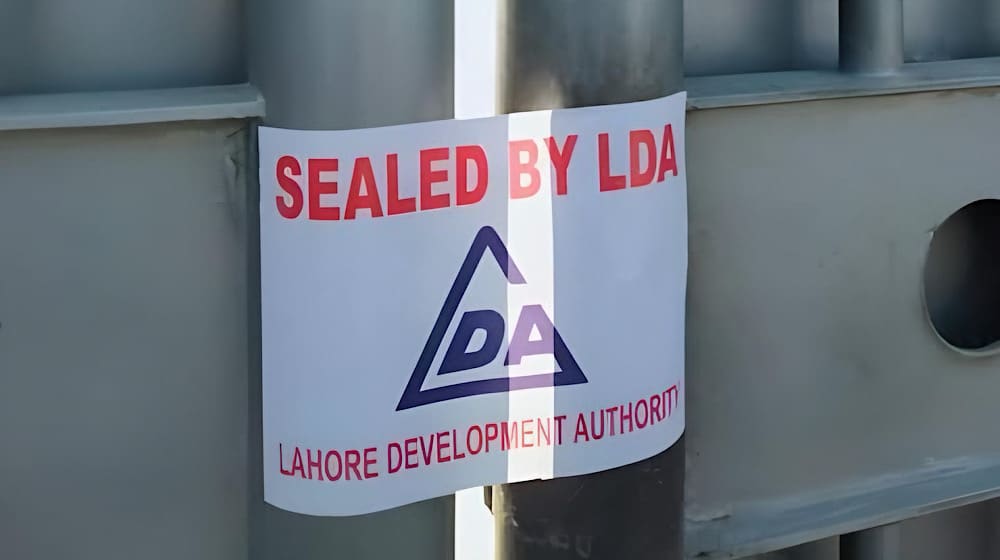
The Lahore Development Authority (LDA) has executed a calibrated enforcement strategy, sealing 203 illegal commercial buildings across Lahore. Directed by DG Tahir Farooq, this initiative targets structural non-compliance and the persistent evasion of essential commercialization fees. This strategic sweep prioritizes urban equilibrium over unregulated expansion, ensuring that Lahore’s development follows a precise architectural baseline.
Mapping the LDA Enforcement Landscape
LDA Town Planning teams deployed across multiple sectors to identify and neutralize zoning violations. Specifically, officials sealed 19 properties in Gulberg and Faisal Town for unauthorized activities. Furthermore, the operation intensified in Gulshan Ravi, Gujjarpura, Samanabad, and Shadbagh, where 84 additional properties were closed. Consequently, these actions demonstrate a zero-tolerance policy toward structural irregularities in high-density residential areas.
The recovery efforts expanded into the UET area and College Road, resulting in 60 sealed properties. Additionally, another 40 properties faced enforcement in Allama Iqbal Town. The list of non-compliant entities included private schools, banks, clinics, and restaurants. Chief Town Planners Asad uz Zaman and Azhar Ali supervised these operations to ensure maximum precision and administrative transparency.
The Situation Room Analysis
The Translation (Clear Context)
Enforcement against illegal commercial buildings is not merely a punitive measure; it is a fiscal necessity. When businesses operate in residential zones without paying commercialization fees, they bypass the system meant to fund local infrastructure. This operation forces a correction in the market by requiring all entities to contribute to the city’s maintenance and utility load-balancing.
The Socio-Economic Impact
For the citizens of Lahore, this move restores residential tranquility and reduces the strain on local utilities. Unregulated commerce often triggers traffic congestion and water shortages in quiet neighborhoods. While the closure of clinics and bakeries may cause short-term inconvenience, the long-term stabilization of zoning laws ensures a more predictable and livable environment for Lahore’s professional class and families.
The Forward Path (Expert Opinion)
This development represents a “Stabilization Move” rather than a total momentum shift. While the LDA has shown impressive tactical efficiency, the long-term solution requires a digitized, real-time zoning map to prevent violations before they occur. Ultimately, this sweep acts as a vital catalyst for restoring the rule of law within the city’s commercial sector.








