

National advancement requires a calibrated approach to resource management and urban integrity. Recently, NAB recovers land totaling 80 acres in Hyderabad, marking a significant correction of institutional leakage within the real estate sector. This reclamation involves prime territory in Deh Ganjo Takkar, valued at approximately Rs 6 billion, which the authorities have now successfully repossessed from Bahria Town.
Strategic Reacquisition: Why NAB Recovers Land in Hyderabad
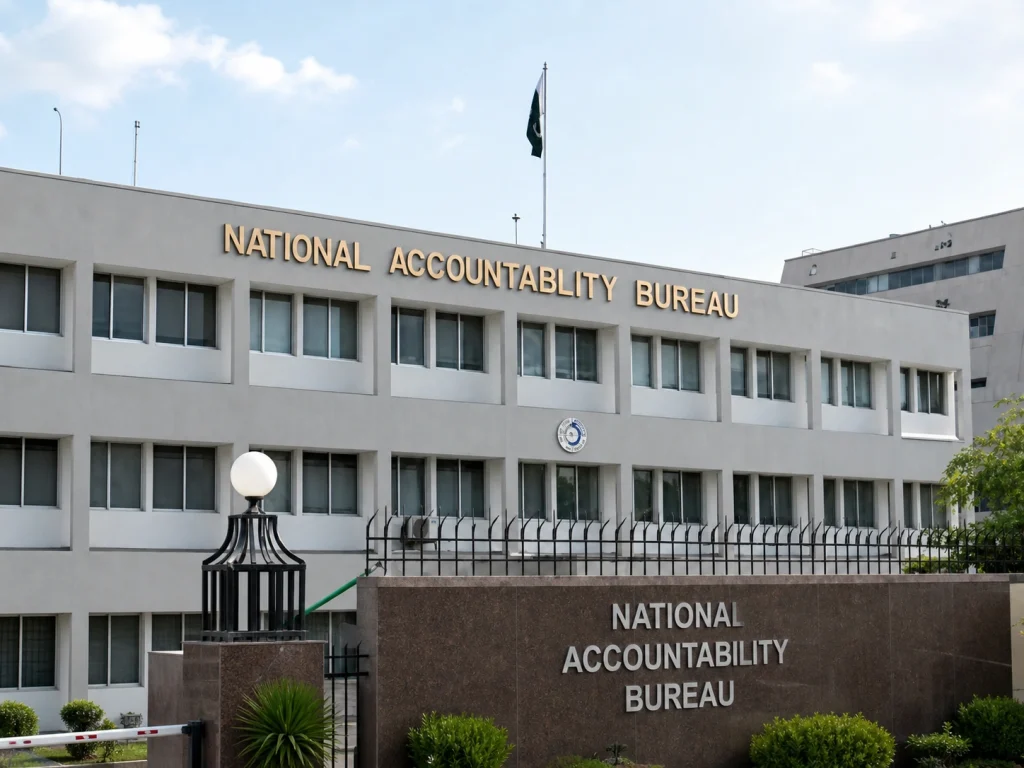
The National Accountability Bureau (NAB) Karachi orchestrated this precision-based recovery after uncovering irregularities in the allotment process. Specifically, the bureau identified that the 80-acre tract within the Gulshan-i-Sarmast housing scheme was obtained through an unauthorized allotment mechanism. Technically, the developers acquired this land for a mere Rs 383 million, a figure significantly below the baseline market valuation. Furthermore, the investigations revealed that even this nominal payment remained partially unsettled.
Violation of Institutional Terms
The original structural intent for this land was the establishment of a university to enhance the regional educational ecosystem. However, the developers failed to adhere to the core conditions attached to the allotment. Consequently, the Hyderabad Development Authority (HDA) acted decisively by canceling the allotment and repossessing the territory. This action includes the forfeiture of the previously paid partial amounts to the state treasury.
- Recovered Asset: 80 Acres of prime urban land.
- Financial Impact: Rs 6 Billion reclaimed for the state.
- Legal Status: Perpetual arrest warrants issued for Malik Riaz and associates.

The Translation: Contextualizing the Recovery
In simple terms, “illegal allotment” refers to a process where state-owned land is transferred to private entities without following the mandatory competitive bidding or legal protocols. By reclaiming this land, the state is essentially fixing a “broken link” in its urban planning chain. This ensures that land meant for public service, like a university, is not diverted into private residential profit without proper authorization.
The Socio-Economic Impact
This development directly impacts the average Pakistani citizen by stabilizing the integrity of public utility land. When 80 acres are recovered, it creates space for potential educational infrastructure that can serve thousands of students. Moreover, these operations prevent the artificial inflation of real estate prices driven by unregulated land grabs, ultimately protecting middle-class investments in urban housing schemes.
The Forward Path: Strategic Analysis
This reclamation represents a Momentum Shift. While land repossessions are often viewed as reactive, the scale of this Rs 6 billion recovery suggests a more proactive baseline for accountability. For Pakistan to achieve systemic efficiency, the transition from “recovery” to “prevention” of illegal allotments must be the next strategic milestone.








