

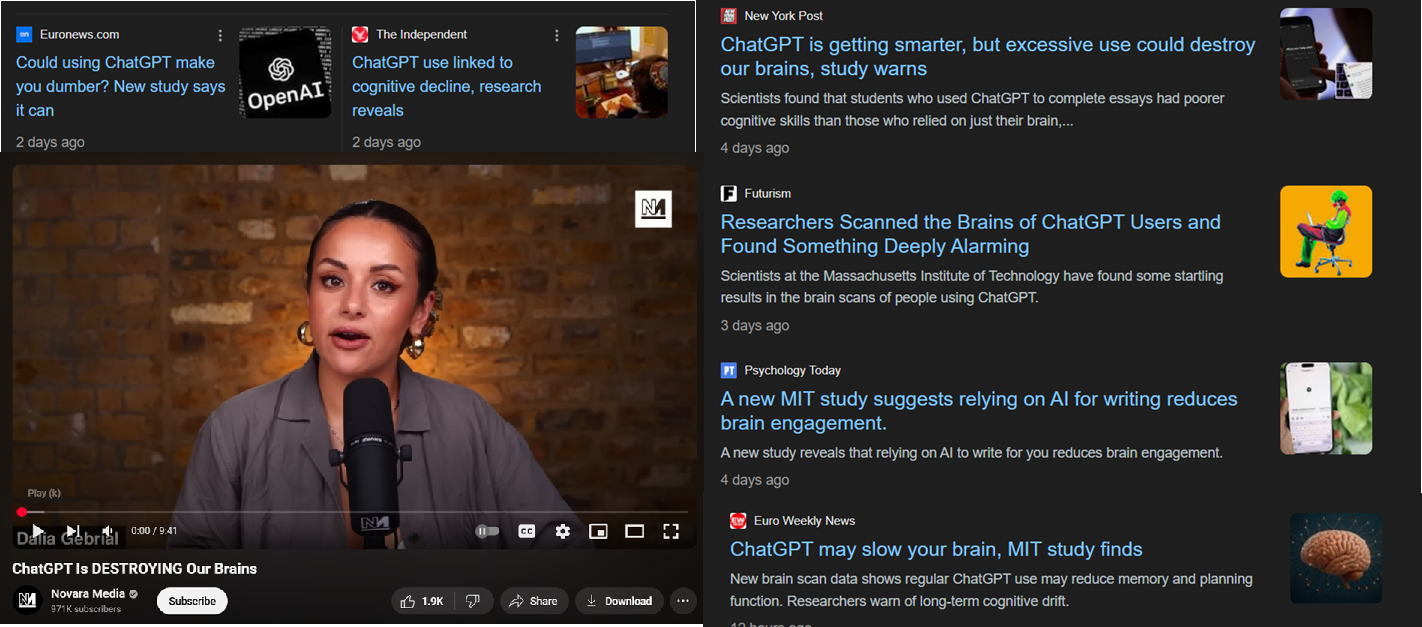
Modern education sits at a critical baseline where the integration of technology must be precisely calibrated to avoid systemic cognitive decline. A recent peer-reviewed study reveals that students who utilize generative tools like ChatGPT and Claude risk significant AI memory loss and poor cognitive health. While these systems act as a catalyst for short-term performance, they simultaneously undermine the structural integrity of long-term knowledge retention.
The Mechanics of AI Memory Loss and Cognitive Offloading
Researchers from Social Sciences & Humanities Open recently conducted a controlled trial involving 120 university participants. They divided the cohort into two strategic groups: one utilized ChatGPT for study assistance, while the other adhered to traditional, effort-based learning methods. Consequently, the results were stark. A surprise retention test conducted 45 days later showed that the AI-reliant group scored an average of only 57.5 percent.
In contrast, the group that studied without AI assistance achieved a superior 68.5 percent. This discrepancy highlights a psychological phenomenon known as cognitive offloading. Essentially, when individuals delegate their reasoning processes to external algorithms, they stop engaging the neural systems required for deep memory formation. Therefore, the convenience of automation becomes a strategic liability for the human brain.
The ‘Desirable Difficulty’ Factor
Meaningful learning requires a specific level of “desirable difficulty.” This concept suggests that effortful thinking actually improves memory durability. However, when AI provides instant solutions, it removes the cognitive struggle necessary to strengthen neural pathways. While students might experience temporary clarity, they fail to achieve long-term mastery. The study clarifies that while AI does not directly damage brain tissue, it creates a “cognitive crutch” that prevents the development of independent skills.
The Situation Room: Analysis
The Translation (Clear Context)
In technical terms, AI is being used as a shortcut rather than a supplement. Think of your brain like a muscle; if a machine does the lifting, the muscle atrophies. AI memory loss occurs because the brain recognizes that the information is “stored” elsewhere, so it doesn’t bother encoding it into long-term storage. The logic here is efficiency—the brain is trying to save energy by offloading tasks, but it is sacrificing the ability to recall that information when the tool is unavailable.
The Socio-Economic Impact
For the Pakistani citizen, this development is a critical warning. As our nation pushes for a digital-first economy, our competitive advantage depends on a high-functioning, skilled workforce. If our students rely on AI to pass exams without retaining the underlying logic, we risk producing a generation of professionals who can “operate” tools but cannot “innovate” or “troubleshoot.” This could lead to a decline in the quality of our local tech industry and engineering sectors, effectively lowering the national human capital value.
The Forward Path (Opinion)
This development represents a Stabilization Move. We must move away from the “wild west” era of unrestricted AI access in classrooms. Educational institutions in Pakistan need to implement “AI-augmented” rather than “AI-replaced” curricula. We must treat AI as a calculator: useful only after the student has mastered the manual math. Precision in integration will ensure that technology serves as a catalyst for our progress, not a substitute for our intelligence.








