

The Punjab government has deployed a strategic baseline for real estate security by making the Green Property Certificate mandatory for all land and property transactions across the province. This structural reform, spearheaded by the Punjab Land Records Authority (PLRA), serves as a calibrated filter to ensure legal transparency and systemic integrity. Consequently, the provincial administration aims to eliminate the historical vulnerabilities found in property transfers through advanced digital verification.
The Translation: De-coding the Verification Protocol
The Green Property Certificate is not merely a document; it is a comprehensive validation of a property’s legal DNA. Under the new mandate, the PLRA requires this certificate before any sale, purchase, or transfer can be finalized. To accelerate initial adoption, authorities have introduced a concessional fee of Rs. 900 for a limited period. This strategic pricing serves as a catalyst for citizens to regularize their holdings within the new digital framework.
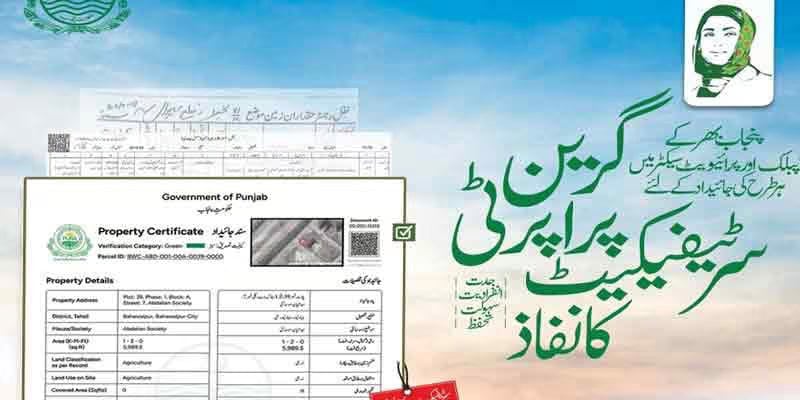
The verification process involves several rigorous checkpoints. Specifically, the PLRA examines the identity of all parties, analyzes ownership history, and audits the property’s legal standing regarding taxes, mortgages, or active disputes. Furthermore, the system integrates field verification with digital record analysis to ensure that on-ground realities align with the centralized database. Precision is the primary objective of this multi-layered scrutiny.
The Socio-Economic Impact: Securing the Citizen’s Asset
For the average Pakistani household, real estate often represents a lifetime of accumulated wealth. This mandatory certification provides a necessary shield against the “qabza” culture and fraudulent documentation that has historically plagued the sector. By standardizing the verification process, the government provides legal protection to both buyers and sellers. Consequently, this leads to increased market trust and could potentially stabilize property valuations by removing “litigation risk” from the equation.

Students and young professionals entering the investment market will benefit from a more predictable and documented environment. When a system removes ambiguity, it invites legitimate capital. In contrast to the opaque dealings of the past, the new digital standard ensures that every transaction is backed by a government-verified clearance, fostering a healthier economic climate for urban and rural development alike.
The Forward Path: A Momentum Shift in Governance
The introduction of the Green Property Certificate represents a significant Momentum Shift for Pakistan’s administrative efficiency. It transitions the real estate sector from a reactive, dispute-heavy model to a proactive, verification-first system. While the initial requirement may add a step to the transaction lifecycle, the long-term benefit of a clean, digital ledger far outweighs the temporary procedural adjustment.

This move is a calibrated step toward a fully integrated digital economy. As the PLRA continues to refine its verification algorithms, we expect to see even faster turnaround times. Ultimately, this reform serves as a structural blueprint for other provinces to follow, ensuring that national advancement is built on a foundation of documented legal clarity.








