

The global race for computational supremacy has a new contender as Bolt Graphics completes the tape-out of its revolutionary Zeus GPU architecture. This milestone marks a decisive transition from FPGA emulation to physical silicon production. Consequently, the California-based startup is now positioned to challenge industry giants with claims of 17 times lower compute costs and an order-of-magnitude performance leap over current flagship hardware.
Strategic Benchmarking on the 12nm Frontier
Bolt Graphics utilized TSMC’s 12nm FFC process for this initial test chip. Although 12nm is considered a mature node, the company uses it as a critical baseline for architectural validation. Engineers calibrated the design to ensure compatibility with advanced 5nm nodes in future production cycles. This tactical approach allows the firm to refine the Zeus GPU architecture before the planned manufacturing surge in late 2027.
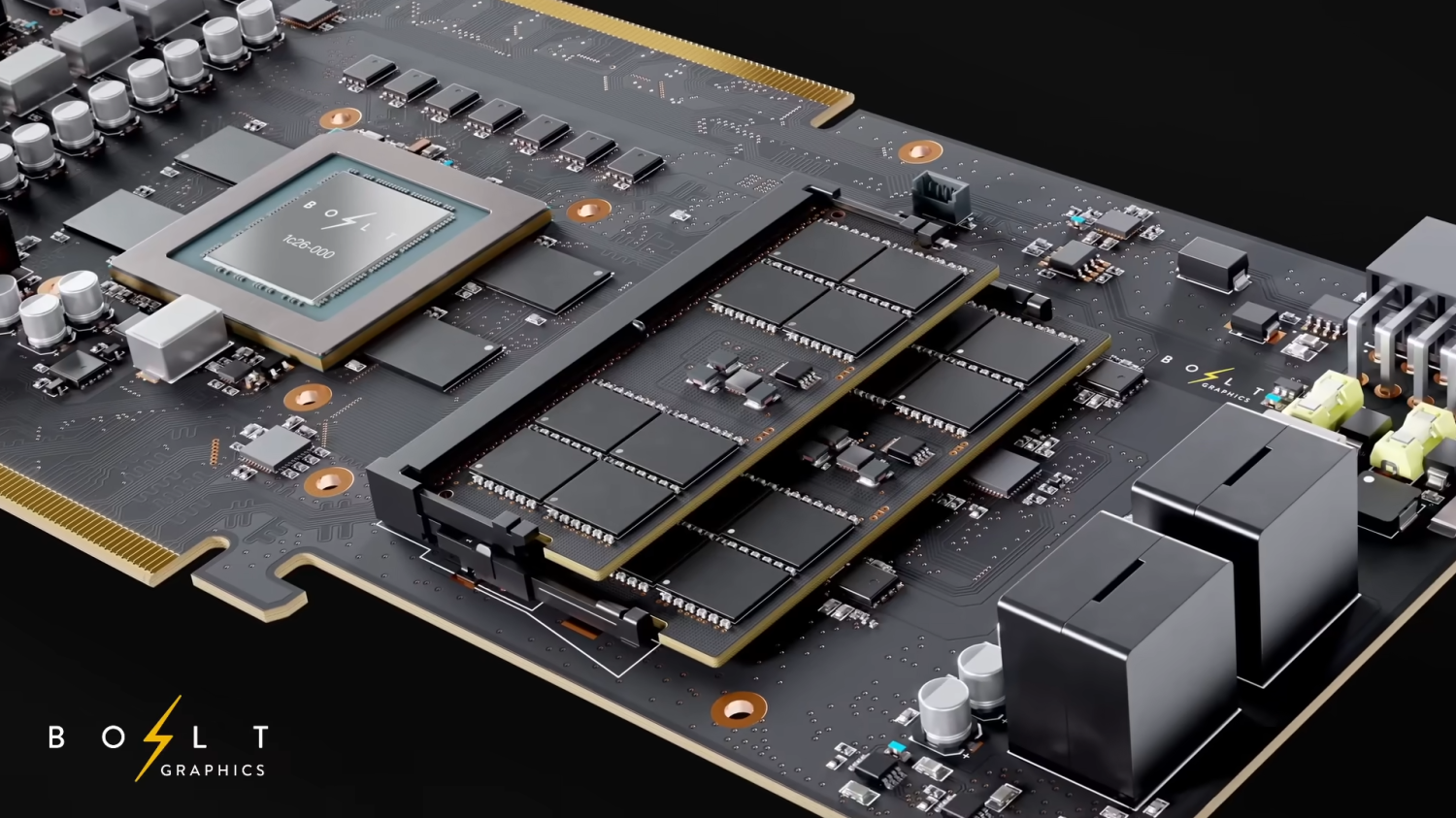
The company targets a combined market value exceeding $55 billion. Specifically, they focus on high-performance computing, electromagnetic simulation, and professional graphics rendering. Furthermore, early internal simulations suggest that Zeus delivers up to 10 times the path tracing throughput of NVIDIA’s GeForce RTX 5090, a claim that has sparked intense industry interest.
Precision Specifications for National Advancement
Structural efficiency defines the Zeus product lineup. Bolt Graphics plans to offer both PCIe cards and 2U server formats to meet diverse industrial needs. The entry-level 120W model produces 5 TFLOPS of FP64 performance, while dual-slot 250W variants double these metrics. Additionally, the inclusion of integrated 400GbE networking ensures that these units function as a catalyst for high-speed data centers.
Memory capacity remains a standout feature of this architecture. Systems can support up to 384GB of memory using a strategic mix of LPDDR5X and DDR5 SO-DIMMs. This massive memory ceiling, combined with 256MB of on-chip cache, addresses the primary bottlenecks in modern AI and simulation workloads.
The Translation: Moving Beyond Emulation
In technical terms, Bolt Graphics has moved from “simulated math” to “physical logic.” For years, their performance claims lived in the world of FPGA—a type of flexible chip used for testing. By completing the “tape-out,” they have finalized the blueprint for a real, mass-producible processor. This proves the architecture works outside of a laboratory setting and can survive the rigors of a standard factory production line.
The Socio-Economic Impact
For the Pakistani landscape, the emergence of a competitor offering 17x lower compute costs is a game-changer. High-end rendering and HPC (High-Performance Computing) currently require massive capital expenditure. If Bolt Graphics delivers on its efficiency promises, it lowers the barrier for local startups, research universities, and animation houses to compete globally without the prohibitive “NVIDIA tax.” This democratization of compute power is essential for a digitizing economy.
The Forward Path: Momentum Shift
We classify this development as a Momentum Shift. While the production timeline has slipped to Q4 2027, the successful tape-out of physical silicon transforms Bolt Graphics from a “paper launch” startup into a legitimate hardware contender. The oversubscribed Series A funding and a $500 million product pipeline suggest that institutional investors see this as a credible structural threat to the current GPU monopoly.









