Voorhees Law Traffic: Why Slow Cars Consistently Catch Up to Fast Cars
Optimizing urban mobility requires a calibrated understanding of vehicular dynamics. A recent study published in Royal Society Open Science introduces the Voorhees Law Traffic, a mathematical model precisely explaining why slower cars frequently catch up to faster vehicles in urban environments. This counter-intuitive phenomenon, often observed by drivers, is structurally dependent on the stochastic nature of traffic signals, fundamentally altering expected travel times. This research, spearheaded by Conor Boland at Dublin City University, offers critical insights for advanced traffic flow prediction and management systems.
The Translation: Deconstructing Urban Traffic Dynamics
The Voorhees Law Traffic concept clarifies a common, yet scientifically puzzling, driving experience. Essentially, a mathematical model simulates two vehicles moving at constant, albeit different, speeds. While intuition suggests the faster car maintains its lead, the model reveals that traffic lights introduce a significant random variable. These signals act as intermittent equalizers, creating windows where a slower car can nullify the time advantage gained by a faster vehicle. The study precisely quantifies this probability, demonstrating the inherent unpredictability embedded in urban transit patterns.
Socio-Economic Impact: Calibrating Commutes for Pakistani Citizens
For Pakistani commuters, especially in densely populated urban centers like Karachi or Lahore, understanding the Voorhees Law Traffic offers tangible benefits. This structural analysis elucidates why route optimization solely based on speed can be misleading. Consequently, this research provides a baseline for developing more efficient traffic management strategies that account for real-world signal interactions, potentially reducing fuel consumption and travel times. Furthermore, it informs policy decisions regarding synchronized traffic light systems, aiming for enhanced urban planning efficiency and a smoother daily experience for students, professionals, and families across the nation.
The Forward Path: A Strategic Shift Towards Optimized Flow
This development unequivocally represents a Momentum Shift in our approach to urban traffic modeling. The Voorhees Law Traffic moves beyond simplistic speed assumptions, integrating the crucial variable of signal timing into a robust predictive framework. This precision is a catalyst for next-generation urban infrastructure planning, enabling Pakistani cities to evolve towards smart, responsive transportation networks. It underscores the imperative for data-driven strategies to improve public mobility and system efficiency, driving national advancement in urban logistics.
Precision Modeling of Vehicular Interactions
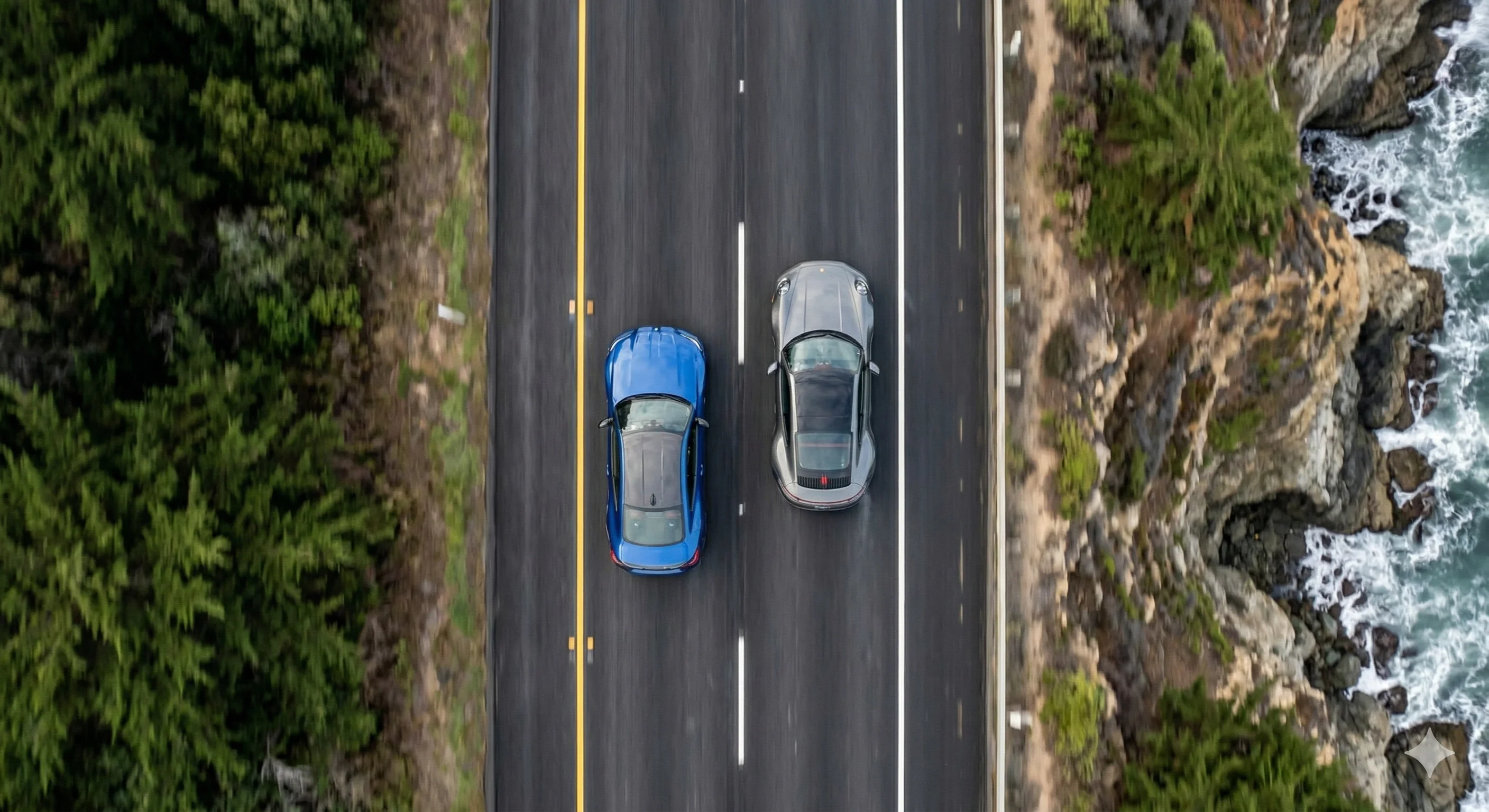
The foundational research focuses on the interaction between two distinct vehicles, each maintaining a constant velocity. Conventional wisdom dictates that a vehicle traveling at a higher speed will consistently maintain its lead. However, the model robustly demonstrates how unpredictable traffic signal timing serves as a critical determinant in this outcome. Drivers cannot predetermine the state of an upcoming light—whether red or green—after executing an overtake. This element of randomness is central to the Voorhees Law Traffic phenomenon.

The Interplay of Traffic Signals and Velocity
Boland’s model meticulously quantifies the probability of a slower car converging with a faster car at a subsequent red light. This calculation is a function of three critical parameters: the initial time advantage accrued by the faster driver during the overtake, the comprehensive duration of the traffic light cycle, and the specific proportion of that cycle allocated to the red phase. Specifically, if the faster vehicle encounters a red light, the slower car gains a structural opportunity to reduce the gap, irrespective of its lower speed.
Unveiling the “Voorhees Law Traffic” Phenomenon
The study formally introduces the “Voorhees Law of Traffic,” drawing an evocative parallel to the fictional character known for relentlessly catching his faster-moving victims. This law postulates that when the initial time advantage secured through an overtake is minimal, the statistical probability of the slower car catching up escalates significantly. Conversely, as this initial advantage increases, the likelihood of such a convergence systematically diminishes. This insight provides a predictive framework for understanding real-world driving patterns and the role of traffic light randomization in the Voorhees Law Traffic effect.
Cumulative Effect Across Urban Grids
Further structural analysis from the research indicates a direct correlation between the number of traffic signals encountered and the probability of a catch-up event. Across extended urban routes, which are inherently characterized by multiple signalized intersections, the chances of experiencing at least one such convergence become substantially elevated. Consequently, this rigorously explains why drivers commonly perceive these catch-up events as a frequent, rather than rare, occurrence in their daily commutes.
Structural Implications for Traffic Management Systems
Beyond merely clarifying a familiar driving paradox, these findings possess profound implications for refining existing traffic modeling paradigms. By integrating the nuanced interactions between individual vehicles and traffic signals, the Voorhees Law Traffic model offers a pathway to more accurate and predictive simulations. The study’s baseline conclusion—that these catch-up events are statistically frequent—provides a precise scientific rationale for their common recollection by drivers, paving the way for data-driven enhancements in urban infrastructure and traffic flow prediction.