

Strategic Leap: Opera Transforms into AI Agentic Browser
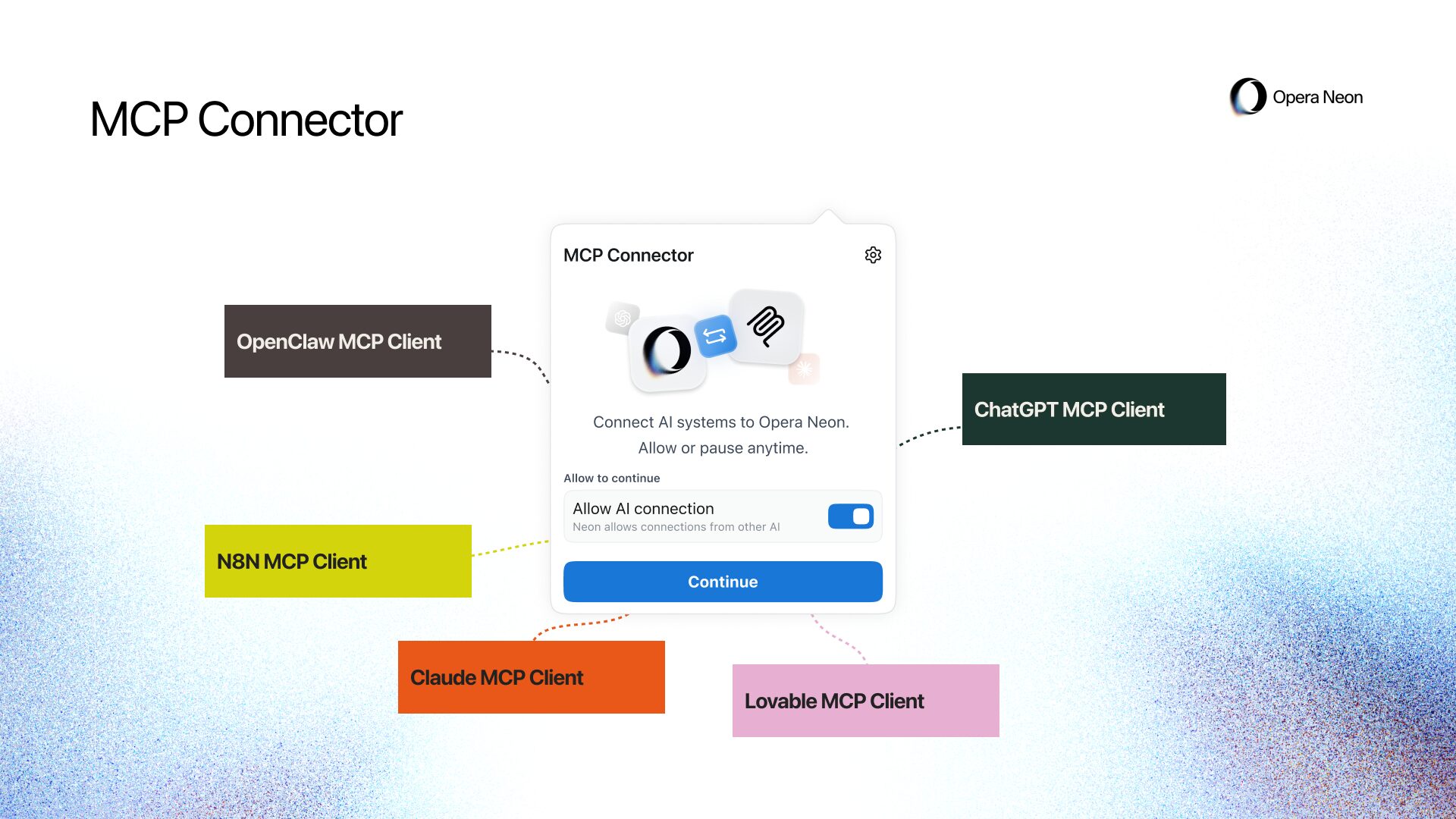
The architectural evolution of web browsing accelerates as Opera introduces a pivotal update for Opera Neon, fundamentally transforming it into an AI agentic browser. This advancement empowers third-party AI assistants like ChatGPT and Claude to directly control browser functions. Consequently, this innovation moves beyond mere AI features, establishing a new baseline for interactive digital environments. The MCP Connector, currently available for paid Neon users, signifies a calibrated shift towards external AI control, promising enhanced efficiency and dynamic user interaction. Opera plans to extend a streamlined version of this functionality across its broader browser ecosystem.
The Translation: Unlocking Direct AI Control
This update is structurally engineered around the Model Context Protocol (MCP), an open standard initially developed by Anthropic. MCP acts as a universal interface, enabling diverse AI tools to connect seamlessly with applications without requiring bespoke integrations for each service. Furthermore, this standardized protocol ensures interoperability. With MCP precisely implemented, compatible AI systems, including industry leaders such as ChatGPT, Claude, n8n, Lovable, and OpenClaw, can establish a direct conduit with Opera Neon. This critical connection grants these AI entities real-time visibility into the browser’s display and empowers them to interact dynamically with its functions, fostering a truly agentic experience.

Socio-Economic Impact: Precision Browsing for Pakistan
For Pakistani citizens, this development represents a significant upgrade in digital task execution. Students can leverage AI for advanced research, automatically compiling information across multiple tabs with unprecedented speed. Professionals gain a powerful co-pilot, automating complex data gathering or cross-referencing tasks, thereby increasing productivity. Consequently, the integration of AI agentic browser capabilities democratizes access to sophisticated digital assistance, fostering a more efficient and less labor-intensive online experience for everyone. Households, particularly in urban centers with robust internet access, can benefit from streamlined online transactions or content management, making the internet a more intuitive and responsive tool.
The Forward Path: A Momentum Shift in Digital Interaction
This strategic integration of third-party AI control within Opera Neon unmistakably signifies a momentum shift in browser technology. It transcends a mere feature addition, recalibrating the very interaction paradigm between users and their digital interfaces. By decentralizing AI control, Opera moves towards an open, extensible model that fosters innovation and efficiency. This structural change positions the browser not merely as a tool for navigation, but as a responsive, intelligent agent capable of executing complex workflows. Therefore, we observe a decisive step towards autonomous digital environments, setting a new industry benchmark.
Expanding Autonomous Capabilities Beyond Native AI
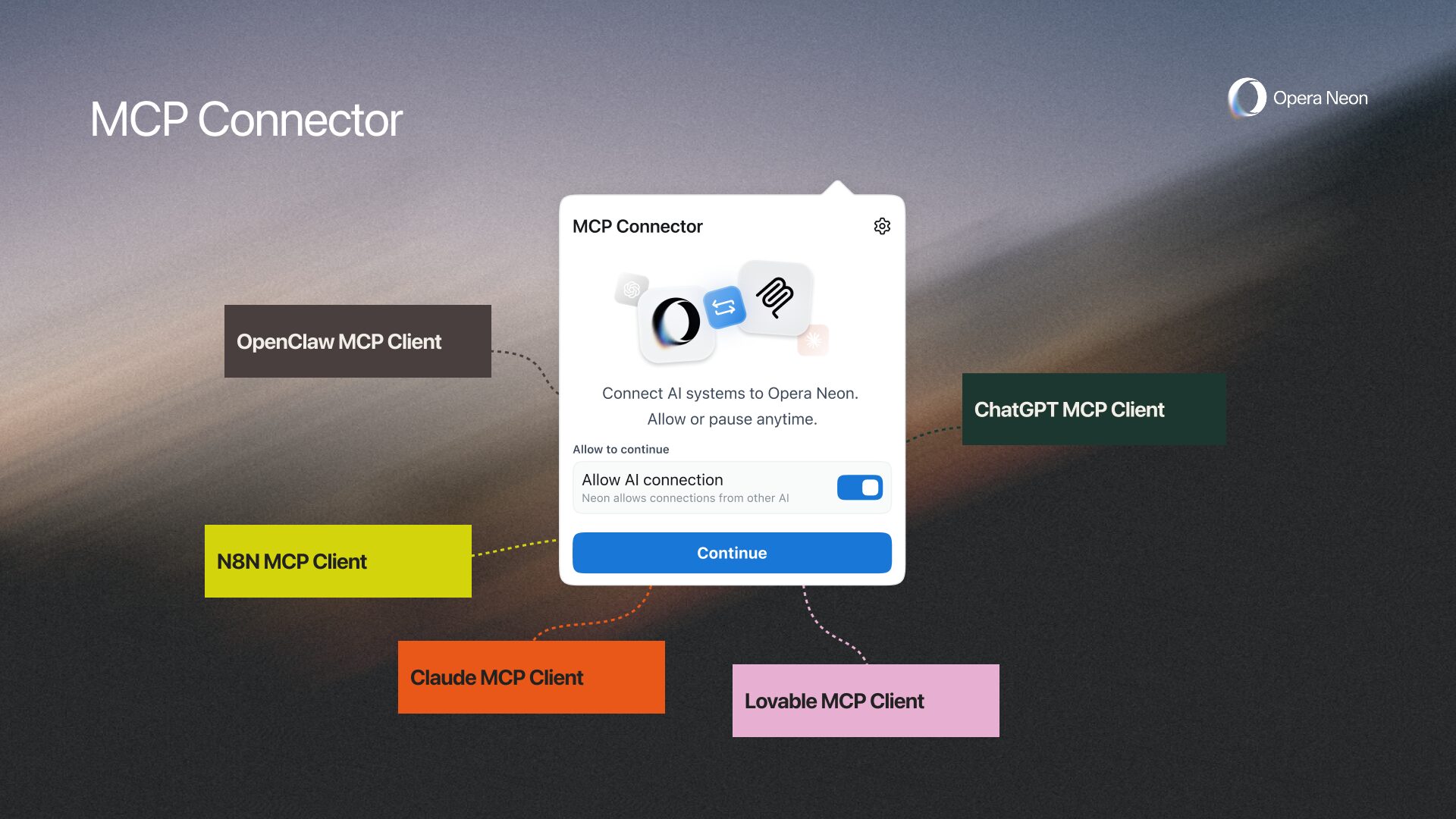
Opera Neon was initially engineered as an agentic browser, featuring a built-in AI designed to perform user-initiated tasks. The MCP Connector fundamentally expands this core capability by enabling external AI tools to integrate seamlessly. Consequently, the browser’s functionality is no longer confined to Opera’s proprietary AI system. Any AI platform that adheres to the MCP standard can now autonomously operate within the browser environment, transforming it into a truly AI agentic browser. This represents a strategic diversification of computational intelligence.
Real-Time Task Execution: Calibrated Efficiency
With this latest update, users can precisely instruct AI tools to execute diverse browsing tasks directly within the Neon interface. This encompasses a broad spectrum of actions, including comprehensive information searches, direct website navigation, seamless page transitions, and complex multi-tab operations. The AI gains immediate access to the current browsing context, facilitating highly effective and relevant task responses. Furthermore, it can fluidly navigate between pages, interact with on-screen elements, and complete intricate multi-step workflows. Users, consequently, are liberated to focus purely on the desired outcomes, optimizing their cognitive load.

The Macro Shift: Towards AI-Controlled Digital Frontiers
This update reflects a profound and strategic shift in the integration trajectory of AI into web browsers. Earlier phases concentrated on augmenting browsers with isolated AI-powered features. This progressed to the introduction of AI-first browsers, exemplified by Perplexity’s Comet and OpenAI’s Atlas. Opera had presciently positioned Neon around task automation. With the MCP Connector, the company now decisively advances this architectural direction by enabling external AI systems to assume direct control over browsing activities. While currently confined to Opera Neon, Opera’s stated intent to expand MCP support signals the imminent widespread availability of these advanced capabilities across its entire browser suite, marking a new era of digital interaction.








