Architecting National Digital Resilience: Understanding MDR vs SOC
To secure Pakistan’s evolving digital infrastructure, a precise understanding of modern cybersecurity frameworks is paramount. This analysis provides a calibrated comparison of **MDR vs SOC** (Managed Detection and Response versus Security Operations Center) models, defining their operational distinctions and strategic advantages for local enterprises. As cyber threats increase in sophistication, integrating robust detection and response capabilities becomes a foundational requirement, impacting system efficiency and national advancement. Effectively choosing between these models is a critical decision for maintaining operational continuity and safeguarding sensitive data.
The Translation: Deconstructing Cybersecurity Operations
The contemporary cybersecurity landscape is characterized by its dynamic and increasingly complex threat vectors. Artificial intelligence now automates intrusion attempts at an unprecedented scale, while Ransomware-as-a-Service (RaaS) models lower the barrier for malicious actors. Businesses across Pakistan frequently find themselves targeted by these advanced threats. Therefore, organizations must move beyond reactive defense to proactive threat neutralization. While a multitude of security tools exist, their efficacy hinges on continuous monitoring, early detection of suspicious activity, and decisive response before incidents escalate into full-scale breaches.
Furthermore, an in-house security team often presents significant budgetary and expertise challenges, particularly for 24/7 coverage. Consequently, MDR and SOC models emerge as leading solutions, each offering distinct operational frameworks to strengthen an organization’s security posture. MDR represents an action-oriented evolution in managed cybersecurity, shifting from mere threat observation to active containment. Understanding these nuances is crucial for strategic deployment.
The Socio-Economic Impact: Fortifying Daily Life for Pakistanis
Cybersecurity breaches extend beyond technical disruption; they halt revenue, erode public trust, and can trigger regulatory penalties. For the average Pakistani citizen, a breach can translate into compromised personal data, disruptions in essential services, or economic instability affecting job markets. For professionals, particularly in the tech sector, robust cybersecurity means a more stable and secure working environment, fostering innovation without constant threat paralysis. Households benefit from secure digital transactions and reliable access to online public services. Implementing effective **MDR vs SOC** strategies directly contributes to a stable digital economy, protecting the data integrity of students, safeguarding financial transactions for families, and ensuring the uninterrupted flow of critical professional operations.
The Forward Path: A Strategic Momentum Shift
The escalating nature of cyber threats necessitates a proactive shift in national cybersecurity strategy. This pivot from reactive defense to integrated, rapid response mechanisms, exemplified by advanced MDR capabilities, represents a significant **Momentum Shift**. It moves Pakistan’s digital infrastructure towards a more resilient and anticipatory posture, crucial for sustained national advancement. This is not merely maintenance; it is a structural upgrade, calibrated to meet future challenges and establish a stronger baseline for digital trust and economic growth. Investing in these models signifies a commitment to safeguarding our digital future.
Understanding Managed Detection and Response (MDR)
MDR is a fully managed cybersecurity service designed for proactive threat detection, exhaustive investigation, and active response. It integrates specialized personnel, streamlined processes, and cutting-edge technology to deliver comprehensive detection and response capabilities as a unified managed service. If traditional cybersecurity employs static defenses, MDR is the dynamic security force that immediately intervenes upon detection of any suspicious activity, commencing an investigation and initiating containment measures.
MDR extends beyond basic alert generation. Instead of merely flagging an issue, MDR validates identified threats, investigates their origins, and executes containment actions to prevent lateral spread. Its core capabilities structurally enhance an organization’s defensive framework:
- 24/7 Continuous Monitoring: Vigilant surveillance across endpoints, networks, servers, and cloud environments ensures constant protection.
- Advanced Threat Detection: Leverages behavioral analytics to identify anomalous activities that evade signature-based tools, ensuring precision in threat identification.
- Proactive Threat Hunting: Expert teams actively search for hidden threats before they can trigger alarms, establishing a robust preemptive defense.
- Incident Investigation & Root Cause Analysis: Comprehensive analysis to understand the precise unfolding of an attack, informing future preventive measures.
- Rapid Containment: Swift actions including device isolation, blocking malicious processes, and neutralizing threats before they propagate across the environment.
Consequently, MDR significantly reduces the operational burden on internal security teams and drastically shortens response times, particularly beneficial for organizations with limited round-the-clock in-house expertise. This outcome-driven model prioritizes not just visibility, but the decisive prevention of threat escalation and minimization of business disruption.

Calibrating Your Defense: Who Needs MDR?
MDR represents an optimal strategic fit for organizations demonstrating specific operational requirements and risk profiles. These include enterprises seeking enterprise-grade defense without the overhead of building an internal Security Operations Center. It offers a scalable, expert-driven solution for complex threat environments. Therefore, MDR is the appropriate consideration for entities that:
- Operate continuously but lack a 24/7 in-house SOC for constant vigilance.
- Are overwhelmed by a deluge of daily security alerts, struggling to differentiate genuine threats from ambient noise.
- Have previously experienced ransomware attacks or data breaches and require enhanced, integrated containment capabilities.
- Seek Digital Forensics and Incident Response (DFIR) expertise without the substantial cost associated with establishing a full internal SOC.
- Require accelerated response mechanisms to contain threats before they can spread across multiple departments or physical sites.
- Prioritize proactive security strategies over reactive incident firefighting.
For Pakistan’s growing enterprises and Small and Medium-sized Enterprises (SMEs), MDR bridges the critical gap between constrained internal resources and the escalating sophistication of threat actors. It provides a robust, externalized security architecture.

The Security Operations Center (SOC) Explained
A Security Operations Center (SOC) functions as a centralized command hub responsible for the continuous monitoring, detection, and management of cybersecurity incidents. When provided by an external vendor, it is frequently termed SOC as a Service (SOCaaS). In scenarios where an IT environment generates thousands of security logs daily across various infrastructure components such as firewalls, servers, and applications, a SOC meticulously collects and reviews these data signals to identify suspicious patterns and potential threats.
Its key operational capabilities include:
- Centralized Log Aggregation: Consolidates security logs from diverse sources, including firewalls, servers, applications, and network devices, into a unified repository.
- SIEM-Based Event Correlation: Employs Security Information and Event Management (SIEM) systems to connect related security events, facilitating the detection of potential incidents that might otherwise go unnoticed.
- Continuous Security Monitoring: Provides constant oversight of the IT environment to identify and alert on security anomalies.
- Incident Escalation: Routes confirmed incidents to the appropriate internal or external response teams for timely remediation.
- Compliance Monitoring & Reporting: Supports adherence to regulatory requirements through diligent monitoring and comprehensive reporting.
In many operational models, the SOC primarily focuses on detection, in-depth analysis, and subsequent escalation. Specialized IT or incident response teams then handle the actual remediation actions. Consequently, SOC is primarily a visibility-focused solution, optimally suited for organizations that already possess structured internal response capabilities and require enhanced governance and compliance oversight.

MDR vs SOC: A Structural Comparison for Strategic Choice
The fundamental distinction between MDR and SOC models resides in the structural organization and operational scope of their detection and response capabilities. While both fortify an organization’s security posture, their approach to threat handling and intervention varies significantly. Choosing the appropriate model requires a precise assessment of internal expertise, risk tolerance, and the criticality of rapid containment.
- Alert Handling: A SOC performs alert monitoring, triage, investigation, and escalation. In contrast, MDR provides alert validation complemented by comprehensive investigation and direct response actions.
- Threat Hunting: Threat hunting within a SOC is often optional or contingent on its maturity level. MDR, however, incorporates proactive threat hunting as a built-in, core capability.
- Response Protocols: SOC-led operations typically involve coordinated remediation with internal IT and response teams. MDR, conversely, offers provider-assisted or provider-led response, streamlining immediate action.
- In-House Skill Requirements: Implementing a SOC generally necessitates moderate to high levels of in-house expertise. MDR significantly reduces this requirement, demanding low in-house skills.
- Speed to Contain Threats: Containment speed in a SOC depends on its maturity, integrated tooling, and established response workflows. MDR ensures faster containment due to its inherently integrated response capabilities.
- Business Impact: A SOC delivers centralized monitoring, detection, and comprehensive security operations management. MDR provides proactive protection, focusing on minimizing disruption through swift action.
In essence, the SOC serves as the central command room, monitoring all digital sensors and alerts, analyzing activity, and coordinating teams. MDR, by contrast, acts as the rapid-response unit, deploying immediately upon threat confirmation to contain and neutralize risks before propagation. The optimal choice is ultimately defined by an organization’s operational maturity, existing internal expertise, specific risk exposure, and the imperative for rapid containment to ensure business continuity.
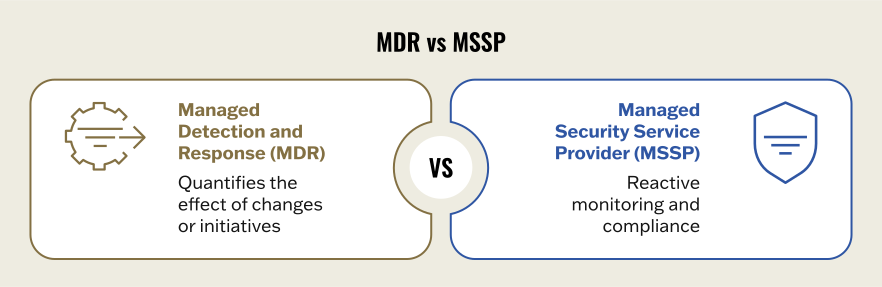
Wateen’s Strategic MDR Solutions for Pakistan
Wateen, a prominent ICT company in Pakistan, stands as a trusted Managed Security Service Provider (MSSP), delivering enterprise-grade cybersecurity solutions across the nation. Wateen’s MDR service offers **24/7 continuous monitoring** across endpoints, servers, and cloud environments, supported by a specialized team of Digital Forensics and Incident Response (DFIR) professionals. This ensures complete visibility and decisively prevents threats from operating undetected within an organization’s digital landscape.
The service is rigorously supported by continuously updated threat intelligence, derived from global attack patterns and adversary behavior analysis, coupled with proactive threat hunting through structured investigations. When incidents inevitably occur, organizations receive actionable response support, including precise containment guidance, detailed remediation steps, and critical post-incident insights. This solution is meticulously designed to scale effectively for both large enterprises and SMEs, providing robust security outcomes without the inherent complexity and cost of establishing an in-house security team.

Architecting a Resilient Cybersecurity Future
Cyber threats represent a constant operational reality for businesses across all sectors and scales. Consequently, the strategic imperative is not whether 24/7 security coverage is necessary, but rather the fundamental nature of that coverage: passive monitoring versus active intervention. While MDR and SOC can function as complementary components within a sophisticated security strategy, their distinct operational models cater to different organizational needs.
Therefore, to transcend reactive security paradigms and forge a resilient, future-ready cybersecurity framework anchored in rapid detection, decisive response, and sustained protection, exploring Wateen’s MDR services is a strategic imperative. Further information and engagement opportunities are available via their dedicated platform.