

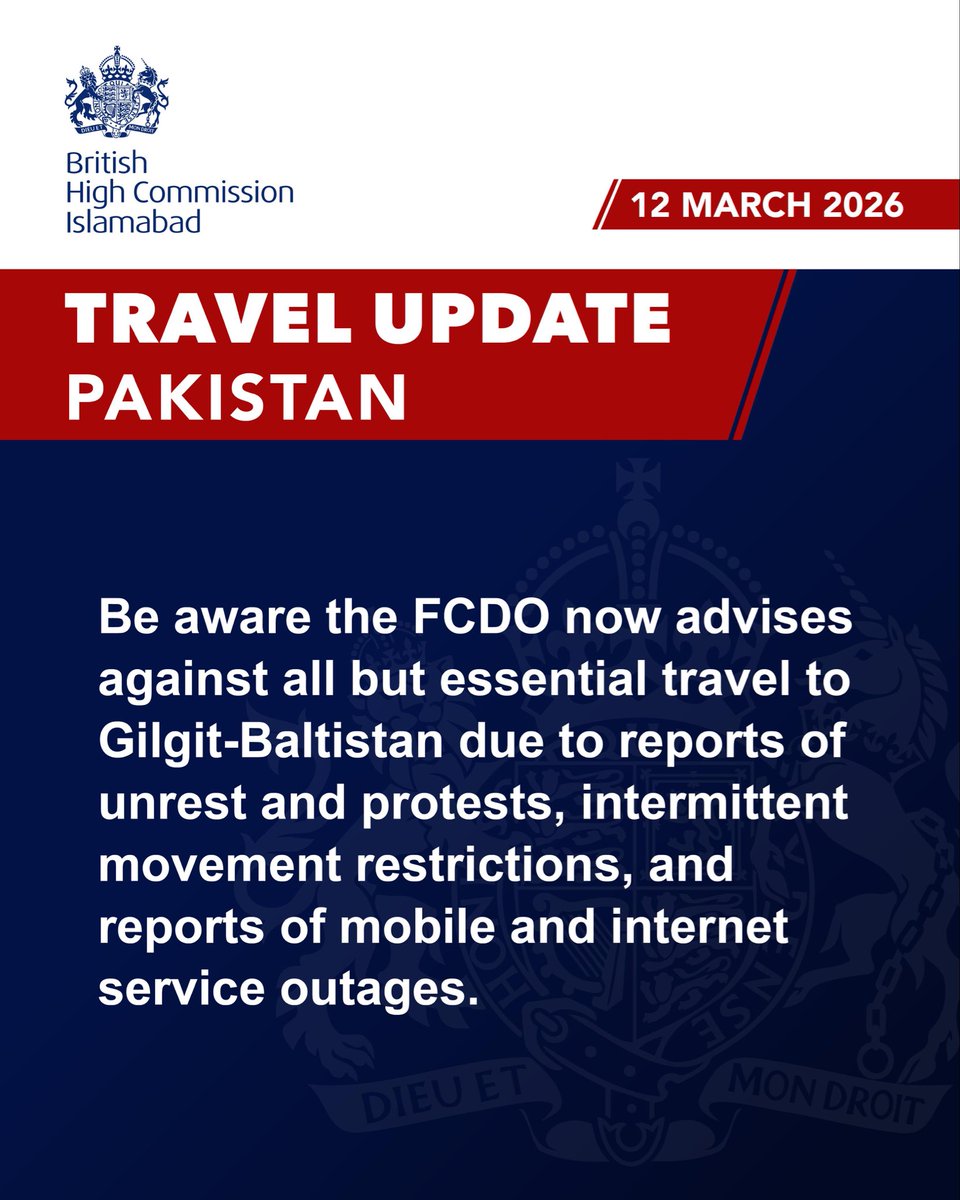
Strategic risk assessment is fundamental for national stability. The United Kingdom’s recent Gilgit-Baltistan travel advisory highlights specific security concerns, urging its citizens to avoid non-essential travel to the region. This calibrated guidance cites reports of unrest, intermittent movement restrictions, and disruptions to essential communication services, necessitating a close examination of regional dynamics.
Gilgit-Baltistan Travel Advisory: FCDO’s Structural Analysis
The Foreign, Commonwealth and Development Office (FCDO) has updated its guidance, now advising against all but essential travel to Gilgit-Baltistan. This reflects a structured response to verifiable regional instability. Specifically, the advisory notes localized unrest and protests, coupled with temporary restrictions on movement and digital communications. Furthermore, this directive carries a critical implication: travel insurance validity may be compromised for British nationals who disregard the advice, transforming a security recommendation into a significant personal liability factor. The FCDO statement directly cites incidents, including an 11-day curfew in Skardu and Gilgit following violent protests, as a baseline for this elevated risk assessment.
Socio-Economic Impact on Pakistani Citizens
For the Pakistani citizen, particularly those residing in or frequently traveling to Gilgit-Baltistan, this travel advisory has a tangible socio-economic impact. Students pursuing education or professionals engaged in tourism and trade face direct operational challenges. Local businesses, especially those reliant on international tourism, consequently experience a calibrated reduction in revenue streams. Rural and urban households alike may encounter indirect disruptions to supply chains and reduced economic activity, creating localized economic pressure points that necessitate strategic mitigation measures. This situation impacts the broader economic calibration of the region.
The Forward Path: Momentum Shift or Stabilization Move?
This development represents a Stabilization Move rather than a Momentum Shift. While the advisory acknowledges existing regional tensions, it does not fundamentally alter the long-term strategic trajectory of Gilgit-Baltistan’s development. Pakistan’s structural response must focus on fortifying internal security protocols and restoring baseline stability. Consequently, a data-driven approach to conflict resolution and proactive communication strategies will be pivotal in re-establishing confidence and fostering an environment conducive to sustainable growth.








