

Revolutionizing Healthcare: The Era of Remote Robotic Surgery
A significant structural shift in medical procedures has commenced as a London surgeon successfully executed the United Kingdom’s first long-distance prostate removal. This groundbreaking remote robotic surgery on a patient located approximately 2,400 kilometers away establishes a new baseline for global healthcare delivery. Professor Prokar Dasgupta, a leading robotic urological surgeon, performed the procedure from The London Clinic, marking a critical advancement in accessible, high-precision medical intervention.
The Translation: Calibrating Surgical Precision Across Continents
This unprecedented operation involved controlling a sophisticated robotic system from London, linked via robust fibre-optic cables to a robot in Gibraltar. The system, equipped with a 3D HD camera and four mechanical arms, allowed Professor Dasgupta to operate with a calibrated delay of merely 0.06 seconds. Furthermore, a redundant 5G connection served as a vital backup, ensuring uninterrupted connectivity throughout the delicate procedure. This dual-layer communication architecture provides a robust framework for future long-distance medical applications.

The Socio-Economic Impact: Expanding Access to Advanced Care
For Pakistani citizens, this innovation represents a profound catalyst for healthcare equity. Traditionally, specialized surgeries necessitate patient travel to centralized medical hubs, a significant barrier for many. Consequently, the proven viability of remote robotic surgery means that highly specialized procedures could potentially be administered by experts located anywhere, transcending geographical limitations. This paradigm shift could dramatically reduce patient wait times, lower logistical burdens for families, and ultimately, bring world-class medical expertise directly to underserved urban and rural communities across Pakistan, enhancing national health outcomes.
The Forward Path: A Momentum Shift in Medical Innovation
This development undeniably signifies a Momentum Shift in global medical capabilities. It extends beyond a mere technological demonstration; it is a structural blueprint for a future where geographical proximity no longer dictates access to life-saving surgical expertise. The successful integration of robotics and secure, high-speed connectivity offers a precision-engineered solution to long-standing challenges in healthcare accessibility and delivery. This initial success will likely accelerate the adoption and refinement of similar tele-surgical systems globally, fundamentally reshaping the operational landscape of advanced medicine.
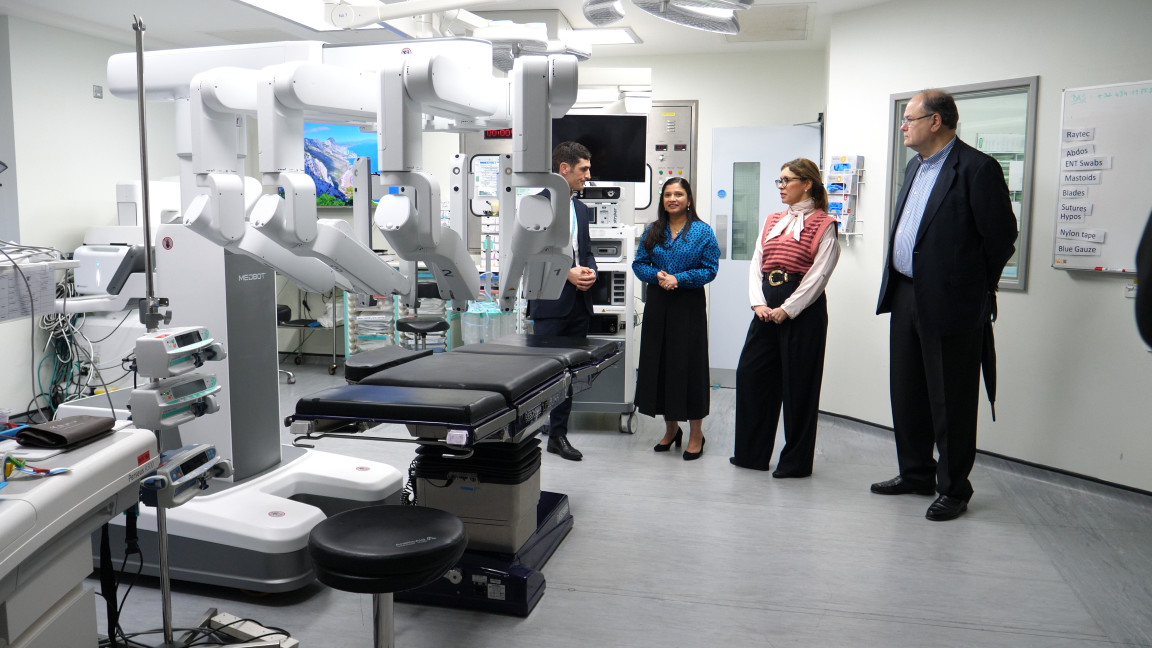
Strategic Advancements in Medical Technology
Paul Buxton, the 62-year-old patient diagnosed with prostate cancer, volunteered for this pioneering procedure, directly contributing to medical progress rather than joining a conventional waiting list. His participation underscores the potential for patient engagement in advancing healthcare frontiers. Moreover, the United Kingdom’s National Health Service (NHS) has explicitly prioritized robotic-assisted surgery, setting an ambitious target of 500,000 robot-supported operations annually by 2035. This strategic national directive validates the trajectory of advanced surgical robotics and anticipates a widespread integration of such efficient, high-precision systems into routine medical practice.








