

Calibrating Financial Transparency: Addressing Unregulated Charity Funding
Pakistan is initiating a critical baseline adjustment in Punjab, targeting the proliferation of unregulated charity funding via anonymous donation boxes. Despite a stringent crackdown by the Punjab Home Department and the identification of 89 banned organizations, these unidentified collection points persist across key public areas. Consequently, this systemic issue raises substantial concerns regarding financial oversight and the potential bypass of the National Action Plan’s objectives to dismantle networks linked to instability. The government’s strategic response involves tracing ownership and enforcing strict registration for transparency, thereby safeguarding public trust and national security.
The Translation: Decoding Anonymous Donations
Anonymous donation boxes, frequently observed at bustling road intersections, vibrant markets, expansive shopping malls, and established banks, represent a silent yet significant challenge to financial accountability. These collections, often secured with chains, operate without clear identification, leaving donors uncertain about the ultimate recipients of their contributions. This mechanism can obscure the flow of substantial funds, potentially channeling billions of rupees outside regulated financial ecosystems, directly undermining efforts to curb illicit financing within the province.
The Socio-Economic Impact: Daily Life and Community Trust
The presence of unmonitored charity collections directly impacts the daily life of a Pakistani citizen by eroding trust and potentially diverting resources from legitimate causes. For students, professionals, and households in both urban and rural Pakistan, transparent charitable giving ensures that donations support verified community development, educational initiatives, or critical social welfare programs. Conversely, a lack of oversight can foster an environment of suspicion, diminish public participation in genuine philanthropy, and inadvertently support entities that do not serve the nation’s progress, thus affecting societal stability and resource allocation.
The Forward Path: Momentum Shift or Stabilization Move?
This development represents a critical Momentum Shift in Punjab’s approach to financial governance. The explicit plan to identify owners and enforce registration for religious seminaries marks a proactive, structural change rather than mere maintenance. Such a calibrated intervention is essential for fortifying the nation’s financial integrity and ensuring that all charitable contributions align with Pakistan’s broader objectives of economic stability and security.
Structural Challenges of Unregulated Charity Funding
The pervasive placement of nameless donation boxes across Punjab poses a significant structural challenge to regulatory authorities. These covert collection methods, often secured and strategically positioned, enable the aggregation of considerable financial assets without immediate traceability. Former civil servant Yawar Mehdi precisely characterized these boxes as “silent routes” of funding. He urged federal and provincial authorities to systematically dismantle what he identified as a dangerous nationwide network, arguing that such unregulated collections decisively undermine state efforts to curb illicit financing activities.
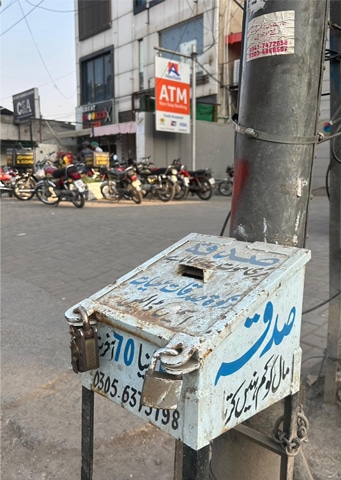
Furthermore, Mehdi advocated for the immediate confiscation of all anonymous donation boxes. He stressed that this action must occur under the stringent supervision of divisional commissioners, deputy commissioners, and district police officers. This procedural rigor would necessitate the maintenance of transparent records for all collected funds, ensuring accountability and preventing further financial ambiguities. Such measures are crucial for establishing a clear, auditable financial baseline.
Strategic Oversight: Pathway to Enhanced Transparency in Charity
Officials within the Punjab Home Department have acknowledged the persistent presence of some anonymous donation boxes. In response, they have outlined a strategic plan to identify their owners following the comprehensive registration of religious seminaries, or madaris. This calibrated approach aims to integrate these institutions into a regulated framework, thereby enhancing overall transparency in charitable operations. Consequently, once registered, all madaris will be legally obligated to declare any donation boxes they place across the province.

In contrast, existing regulations already mandate that donation boxes belonging to registered charities and NGOs display proper identification. This includes clear organization names and verifiable registration codes. This established protocol provides a critical benchmark for the new enforcement efforts, ensuring that all entities engaged in public fundraising adhere to consistent standards of transparency and accountability, thereby strengthening the regulatory framework for unregulated charity funding.








